
Knee and Sports Injury Therapy at Home: ACL and Meniscus
In-Home Knee and Sports Injury Therapy in Oakland and Macomb County, Michigan
Rebuild strength, stability, and confidence, from injury to return to activity.
ELEVATE provides in-home physical and occupational therapy for adults recovering from ACL tears, meniscus tears, and other knee and sports injuries in Oakland and Macomb County, Michigan. Licensed therapists work on motion, strength, movement control, and daily tasks in your own home, alongside your physician or surgeon. Visits are private-pay and one-on-one.
- The knee is held together by four main ligaments and cushioned by two C-shaped pads of cartilage called the menisci. The ACL (anterior cruciate ligament) and the meniscus are two of the most commonly injured structures.
- An ACL tear usually happens during pivoting, cutting or jumping, often without any direct contact. Meniscus tears can happen in sports, and also in older adults with an awkward twist.
- Some of these injuries are managed without surgery, and some need it. Either way, rehabilitation is central, from calming the knee to regaining strength, control and confidence.
- Physical therapy restores motion, strength and movement control and guides return to activity. Occupational therapy helps with daily tasks while you use crutches or a brace.
- ELEVATE Therapy Services brings therapy to your home in Oakland and Macomb County, Michigan. Visits are private-pay and one-on-one.
How the knee works and what goes wrong
The American Academy of Orthopaedic Surgeons (AAOS) explains that three bones meet at the knee: the thighbone (femur), the shinbone (tibia) and the kneecap (patella). Four primary ligaments act like strong ropes to hold the bones together. The collateral ligaments (MCL and LCL) sit on the sides and control side-to-side motion. The cruciate ligaments cross inside the joint. The ACL, in front, prevents the shinbone from sliding forward under the thighbone and gives rotational stability. The posterior cruciate ligament (PCL), in back, keeps the shinbone from moving backward too far.
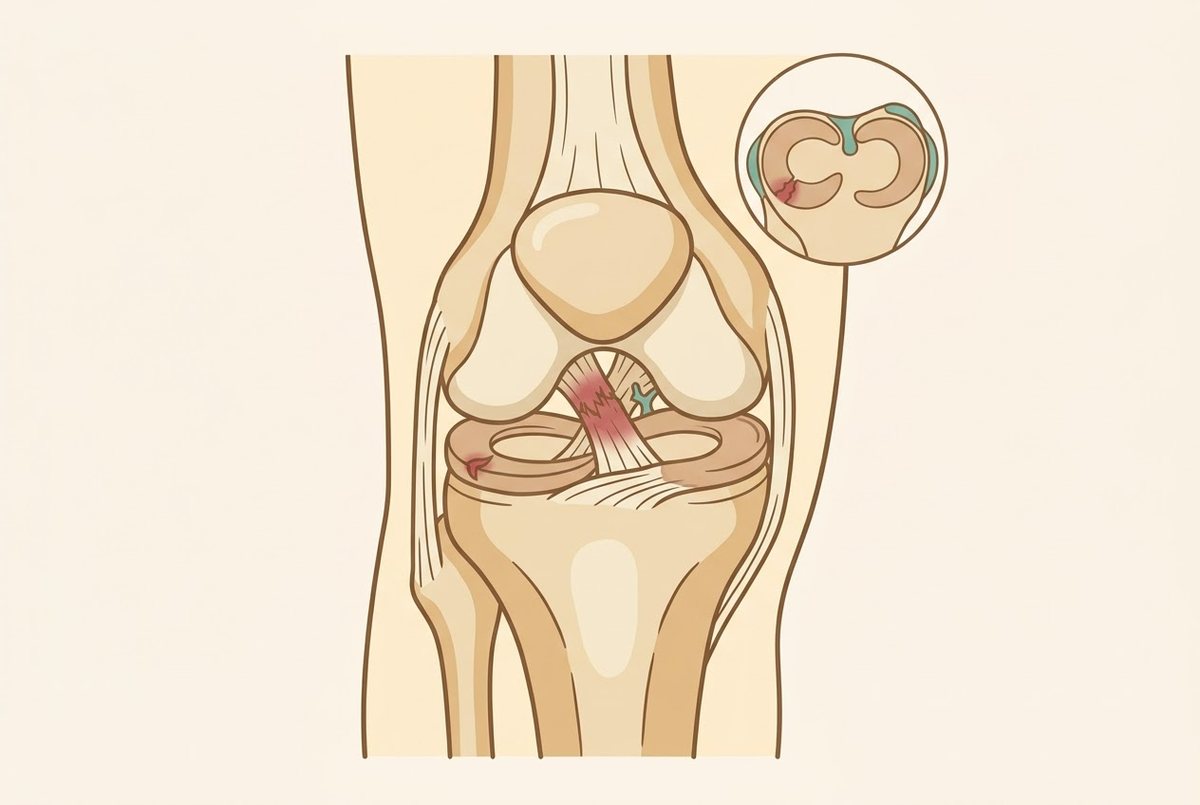
Between the thighbone and shinbone sit two wedge-shaped pieces of fibrocartilage, the menisci, which act as shock absorbers, share load and add stability.
Causes and risk factors
ACL injuries
Anyone can tear an ACL, but it most often happens when a person pivots, cuts or jumps with the leg fully straightened on impact with the ground, as in volleyball, soccer, football and basketball. Most ACL injuries happen without direct impact to the knee: the ligament is overwhelmed by sudden extreme forces that it cannot stabilize.
Meniscus tears
Acute meniscus tears often happen during sports, through contact or non-contact pivoting and cutting injuries, and commonly occur with ACL tears. As people age, the meniscus becomes worn and more prone to tearing, so an awkward twist when getting up from a chair can be enough. Athletes in contact sports are at higher risk.
Other factors that raise injury risk include a previous knee injury, muscle weakness or imbalance, fatigue, and sudden increases in training. A therapist can assess these.
Symptoms
ACL tear
- A popping noise and a feeling that the knee gives out from under you
- Pain with swelling, which develops within about 24 hours
- Loss of full range of motion
- Tenderness along the joint line and discomfort when walking
- Instability: returning to normal activity can worsen the feeling that the knee gives way and risks damaging other structures
Meniscus tear
- You might feel a pop, but many people can still walk and some athletes keep playing
- Over two to three days the knee becomes stiffer and more swollen
- Pain, catching or locking of the knee, and the sensation that the knee gives way
- Inability to move the knee through its full range
When to get help
- See your physician promptly after a twisting injury with a pop, swelling, locking or giving way, so the cause can be identified.
- Locked knee: a knee that is stuck and cannot fully straighten needs prompt evaluation.
- Calf pain, swelling, warmth or redness after an injury or surgery can signal a blood clot and needs urgent attention.
- Do not return to sport on a knee that gives way before you are cleared.
How knee injuries affect daily life
| What a person may notice | Why it happens | Who helps |
|---|---|---|
| A knee that gives way or feels unstable | A torn ACL or other ligament no longer controls the shinbone, and the surrounding muscles may not compensate. | Physical therapy |
| Swelling, stiffness and trouble bending or straightening the knee | Injury causes swelling in the joint, and the muscles around the knee shut down. | Physical therapy |
| Catching or locking when moving | A torn piece of meniscus can catch between the joint surfaces. | Your physician, with physical therapy |
| Trouble with stairs, getting up from a chair or squatting | Weak thigh and hip muscles and pain with load make these tasks hard. | Physical therapy |
| Difficulty with daily tasks on crutches or in a brace | Reduced weight bearing and limited motion affect dressing, bathing, cooking and getting around. | Occupational therapy, physical therapy |
| Fear of returning to sport | After a major injury many people lose confidence in the knee. | Physical therapy, with your physician |
How care works
AAOS notes that if you injure your ACL you may need surgery to regain full function, depending on factors such as the severity of the injury, your age, how much joint wear you have, whether you feel instability and your activity level. Many meniscus tears do not need immediate surgery: if symptoms do not persist and there is no locking or swelling, treatment can begin with rest, ice, compression, elevation and anti-inflammatory medicine, with injections or surgery considered if needed.
The APTA clinical practice guidelines for knee ligament sprains and for meniscal and articular cartilage lesions support progressive exercise, restoring motion and strength, and movement training. Whether or not surgery is chosen, rehabilitation takes time, and returning to cutting and jumping sports is based on your physician’s clearance and your measured strength, control and confidence rather than a calendar. After surgery, rehabilitation follows your surgeon’s protocol (see our post-surgical therapy guide).
What physical and occupational therapy each do
Physical therapy: from injury to return to activity
- Assessment of swelling, motion, strength, balance, stability and movement patterns
- Early work to restore full knee extension and bending and activate the thigh muscles
- Progressive strengthening of the thigh, hip and calf muscles
- Balance, agility and landing and cutting mechanics, and running and jumping programs as appropriate
- Testing of strength and control to guide return to sport, with your physician’s clearance
- A written home program, and training for the demands of your sport or job
Occupational therapy: managing daily life while the knee heals
- Safe ways to dress, bathe, cook and get in and out of a car on crutches or a brace
- Home setup for stairs, bathroom and bed
- Equipment recommendations such as a shower chair or raised toilet seat
- Pacing and energy conservation during recovery
Supporting services
What an ELEVATE home visit looks like
- Review: how the injury happened, symptoms, medicines, your doctors’ recommendations and any surgeon’s protocol.
- Assessment: swelling, motion, strength, balance, stability and movement.
- Home setup: stairs, bathroom, bed and car, and any equipment.
- Plan: goals that matter to you and a written home program.
- Communication: progress shared with your physician or surgeon as appropriate.
ELEVATE serves adults in Oakland and Macomb County, Michigan, with licensed physical and occupational therapists. See Payments & Insurance for details.
Questions families ask
Does a torn ACL always need surgery?
Can a meniscus tear heal without surgery?
When can I return to sport?
Should I wear a brace?
Is it safe to walk on a torn meniscus or ACL?
Do I need a referral or does insurance cover this?
Does ELEVATE replace my doctor or surgeon?
Trusted resources for knee and sports injuries
These organizations are the leading sources of education and support for this condition. We are not affiliated with them.
Related guides
Browse every condition we treat on our Conditions We Treat page.
Sources and medical note
- American Academy of Orthopaedic Surgeons, OrthoInfo: Anterior Cruciate Ligament (ACL) Injuries and Meniscus Tears.
- Logerstedt DS et al. Knee Stability and Movement Coordination Impairments: Knee Ligament Sprain Revision 2017. Journal of Orthopaedic & Sports Physical Therapy, 2017 (APTA).
- Logerstedt DS et al. Knee Pain and Mobility Impairments: Meniscal and Articular Cartilage Lesions Revision 2018. Journal of Orthopaedic & Sports Physical Therapy, 2018 (APTA).
This page is educational and is not medical advice. It does not replace your physician’s or surgeon’s care. Always follow your physician’s instructions. After an injury with severe pain, a deformed knee, a cold or numb foot, or if you cannot bear weight, call 911 or go to the emergency department.
Contact Elevate Therapy Services
Need to reach us? Use our web form to send a message now, or contact us using one of the methods below.
We will be in contact within one to two business days.
Phone: (248) 266-5721
Fax: (586) 788-1704
