
Shoulder Pain, Rotator Cuff and Frozen Shoulder Therapy at Home
In-Home Shoulder Therapy in Oakland and Macomb County, Michigan
Restore motion and strength, and use your arm again without pain.
ELEVATE provides in-home physical and occupational therapy for adults with rotator cuff problems, frozen shoulder, and other shoulder conditions in Oakland and Macomb County, Michigan. Licensed therapists work on motion, strength, and daily tasks in your own home, alongside your physician or surgeon. Visits are private-pay and one-on-one.
- The shoulder is a ball-and-socket joint held in place by the rotator cuff, four muscles whose tendons wrap around the top of the arm bone. It has more motion than any other joint, so it is also easy to injure.
- The most common causes of shoulder pain and loss of function in adults are rotator cuff problems and frozen shoulder (adhesive capsulitis). Labral tears of the socket rim also occur.
- Most rotator cuff tears improve without surgery. Frozen shoulder usually improves with time and stretching, although recovery can be slow.
- Physical therapy restores motion and strength, and occupational therapy helps you do daily tasks while the shoulder heals.
- ELEVATE Therapy Services brings therapy to your home in Oakland and Macomb County, Michigan. Visits are private-pay and one-on-one.
How the shoulder works and what goes wrong
The American Academy of Orthopaedic Surgeons (AAOS) describes the shoulder as a ball-and-socket joint made of three bones: the upper arm bone (humerus), the shoulder blade (scapula) and the collarbone (clavicle). The ball of the humerus sits in a shallow socket in the shoulder blade, so the joint depends on soft tissue for stability. The rotator cuff, a group of four muscles whose tendons cover the head of the humerus, helps lift and rotate the arm. A fluid-filled sac called a bursa lets the tendons glide.
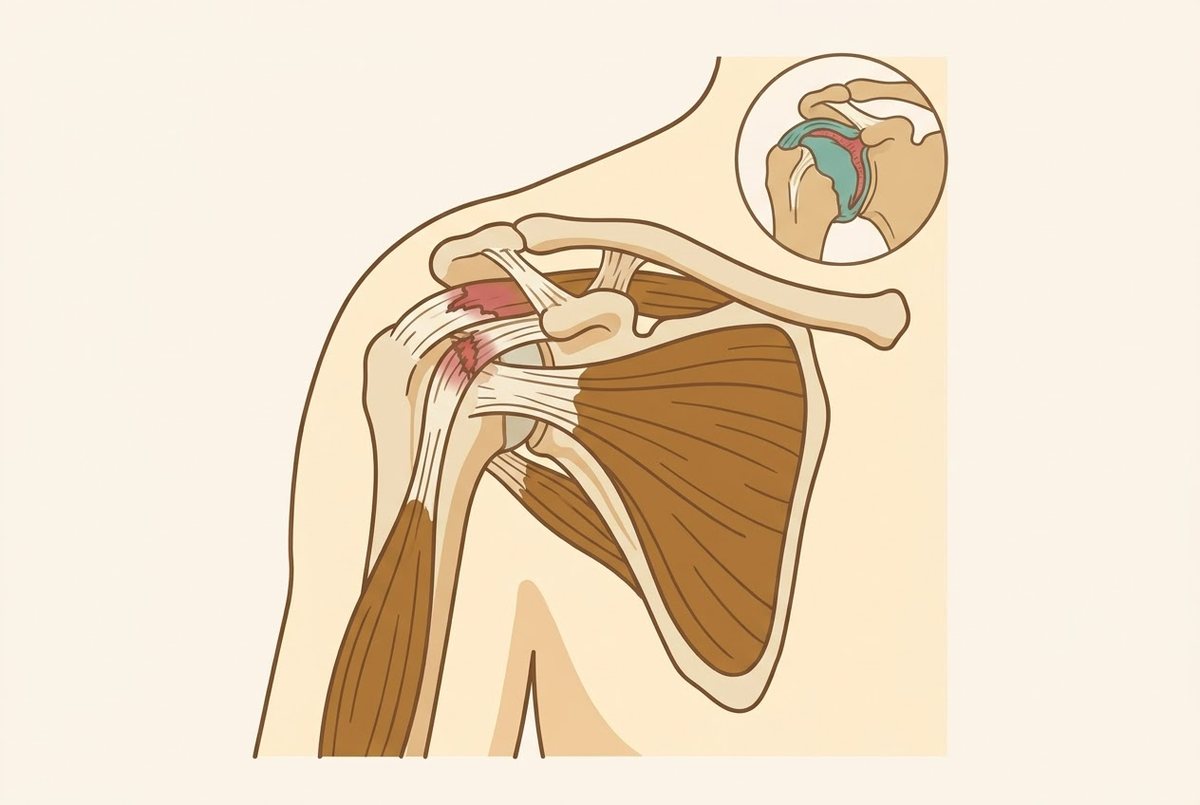
Related problems such as bursitis (an inflamed bursa) and tendinopathy (irritated or degenerating tendons) can cause similar shoulder pain, which is why a careful assessment matters.
Causes and risk factors
Rotator cuff tears
AAOS identifies two main causes. An acute tear can follow a fall on an outstretched arm or lifting something too heavy with a jerking motion, and may occur with other injuries such as a broken collarbone or a dislocated shoulder. A degenerative tear results from wear that develops slowly over time. People over 40 are at greater risk, as are people who do repetitive lifting or overhead activity, such as painters, carpenters, tennis players and baseball pitchers.
Frozen shoulder
The cause of frozen shoulder is not fully understood. It most commonly affects people between 40 and 60, and occurs more often in women than men. Diabetes is a clear risk factor, and so are thyroid conditions, Parkinson’s disease and heart disease. It can also develop after a shoulder has been immobilized for a time, for example after surgery, a fracture or another injury, which is why gentle early motion after injury or surgery is encouraged.
Symptoms
Rotator cuff tear
- Pain at rest and at night, especially when lying on the affected shoulder
- Pain when lifting or lowering the arm, or with certain movements
- Weakness when lifting or rotating the arm
- A crackling sensation (crepitus) when moving the shoulder
- A sudden tear from a fall can cause intense pain, a snapping sensation and immediate weakness. A tear can also cause no symptoms
Frozen shoulder
- Freezing: pain slowly increases and motion is lost, typically over 6 weeks to 9 months
- Frozen: pain may ease but stiffness remains and daily tasks can be hard, typically over 4 to 6 months
- Thawing: motion slowly returns, with a return to normal or close to normal taking from 6 months to 2 years
When to get help
- See your physician for shoulder pain that does not improve after a few weeks, pain that wakes you at night, or weakness lifting your arm.
- Get care promptly after a fall or injury with sudden weakness or a snapping sensation, because early treatment can matter for tears.
- Seek care for a hot, red, swollen shoulder with fever.
- Do not start shoulder exercises for a suspected tear without checking with your doctor or therapist.
How shoulder problems affect daily life
| What a person may notice | Why it happens | Who helps |
|---|---|---|
| Pain reaching overhead, behind the back or across the body | Irritated or torn tendons and a tight capsule limit motion and make the arm painful to lift. | Physical therapy |
| Pain at night or when lying on the shoulder | Inflamed tendons and bursa are compressed when lying on the shoulder. | Your physician, with physical therapy and occupational therapy for positioning |
| A weak arm that cannot lift a cup, comb hair or reach a shelf | A torn or weak rotator cuff cannot lift and stabilize the arm. | Physical therapy, occupational therapy |
| A stiff shoulder that will not move, even with help | In frozen shoulder the joint capsule is thick and tight. | Physical therapy |
| Trouble dressing, bathing, cooking or driving | Daily tasks depend on reaching and lifting that the shoulder can no longer do comfortably. | Occupational therapy |
| Poor sleep and frustration | Night pain and loss of function affect sleep and mood. | Whole team, with your physician |
How care works
AAOS reports that in about 80 to 85% of people with rotator cuff tears, nonsurgical treatment relieves pain and improves function. Treatment can include rest and activity modification, anti-inflammatory medicine, specific strengthening and flexibility exercises with physical therapy, and sometimes a steroid injection. Surgery is considered if these do not help, if the tear is large or traumatic, or if function is lost, and the surgeon decides what is best.
For frozen shoulder, AAOS names physical therapy with a focus on shoulder flexibility as the primary treatment, with stretching and range-of-motion exercises, sometimes preceded by heat. Controlling other health conditions, such as diabetes, can also help recovery. Steroid injections or a procedure called hydrodilatation are options if symptoms persist. The APTA clinical practice guidelines for rotator cuff tendinopathy and for adhesive capsulitis support education, exercise and individualized rehabilitation. After shoulder surgery, rehabilitation follows your surgeon’s protocol (see our post-surgical therapy guide).
What physical and occupational therapy each do
Physical therapy: restoring motion and strength
- Assessment of shoulder and neck motion, strength, posture and shoulder-blade movement
- For rotator cuff problems: graded strengthening of the cuff and shoulder-blade muscles, with activity changes to unload the tendon
- For frozen shoulder: gentle, regular stretching and range-of-motion work matched to the stage, with heat or other comfort measures
- Hands-on techniques as appropriate, and posture and movement retraining
- After surgery or injury: a stepwise program that follows your surgeon’s protocol
- A written home program, and a plan to return to work, sport or hobbies
Occupational therapy: getting through the day while it heals
- One-handed and shoulder-saving ways to dress, bathe, cook and groom
- Sleep positioning and pillow support for night pain
- Workstation, kitchen and storage changes to reduce reaching
- Adaptive equipment such as long-handled tools and dressing aids
- Pacing strategies and guidance on lifting and carrying
Supporting services
What an ELEVATE home visit looks like
- Review: your history, the injury or onset, medicines and your doctors’ recommendations, including any surgeon’s protocol.
- Assessment: shoulder and neck motion, strength, posture and daily tasks.
- Home setup: bed, kitchen, bathroom, workstation and car.
- Plan: goals that matter to you and a written home program.
- Communication: progress shared with your physician or surgeon as appropriate.
ELEVATE serves adults in Oakland and Macomb County, Michigan, with licensed physical and occupational therapists. See Payments & Insurance for details.
Questions families ask
Do all rotator cuff tears need surgery?
How long does frozen shoulder last?
Should I rest my shoulder completely?
Why does my shoulder hurt at night?
Can therapy help if I have a labral tear?
Do I need a referral or does insurance cover this?
Does ELEVATE replace my doctor or surgeon?
Trusted resources for shoulder problems
These organizations are the leading sources of education and support for this condition. We are not affiliated with them.
Related guides
Browse every condition we treat on our Conditions We Treat page.
Sources and medical note
- American Academy of Orthopaedic Surgeons, OrthoInfo: Rotator Cuff Tears and Frozen Shoulder (reviewed by the American Shoulder and Elbow Surgeons).
- Desmeules F et al. Rotator Cuff Tendinopathy Diagnosis, Nonsurgical Medical Care, and Rehabilitation: A Clinical Practice Guideline. Journal of Orthopaedic & Sports Physical Therapy, 2025 (APTA).
- Kelley MJ et al. Shoulder Pain and Mobility Deficits: Adhesive Capsulitis. Journal of Orthopaedic & Sports Physical Therapy, 2013 (APTA).
This page is educational and is not medical advice. It does not replace your physician’s or surgeon’s care. Always follow your physician’s instructions. For shoulder or arm pain with chest pain, shortness of breath or signs of stroke, call 911 immediately.
Contact Elevate Therapy Services
Need to reach us? Use our web form to send a message now, or contact us using one of the methods below.
We will be in contact within one to two business days.
Phone: (248) 266-5721
Fax: (586) 788-1704
