
Elbow and Tendon Pain Therapy at Home: Tennis Elbow, Golfer’s Elbow and Bursitis
In-Home Elbow and Tendon Therapy in Oakland and Macomb County, Michigan
Change the load, rebuild the tendon, and get back to the things you do.
ELEVATE provides in-home occupational and physical therapy for adults with tennis elbow, golfer’s elbow, bursitis, and other overuse tendon problems in Oakland and Macomb County, Michigan. Licensed therapists work on tasks, tools, strength, and movement in your own home, alongside your physician. Visits are private-pay and one-on-one.
- Tendons connect muscle to bone. When they are overloaded by repeated motions, they can become painful and degenerate, a problem called tendinopathy. At the elbow this is called tennis elbow (outside) or golfer’s elbow (inside), and it affects far more than athletes.
- Related problems include bursitis, inflammation of the small fluid-filled sacs that cushion tendons and bone, at the elbow, shoulder, hip and other joints.
- Most overuse tendon problems improve with load management, targeted exercise and changes to how a task is done. Rest alone often does not fix them.
- Occupational therapy adjusts tasks, tools and workstations, and physical therapy builds tendon and muscle strength and movement control.
- ELEVATE Therapy Services brings therapy to your home in Oakland and Macomb County, Michigan. Visits are private-pay and one-on-one.
How tendons and the elbow work and what goes wrong
The American Academy of Orthopaedic Surgeons (AAOS) describes tennis elbow, also called lateral epicondylitis, as a painful condition of the elbow caused by overuse. It involves degeneration, or in some cases tiny tears (microtearing), of the tendons that join the forearm muscles to the bone on the outside of the elbow. The forearm muscles and tendons become damaged from repeating the same motions again and again, which leads to pain and tenderness on the outside of the elbow. Playing tennis or other racquet sports can cause it, but several other sports and activities also put people at risk.
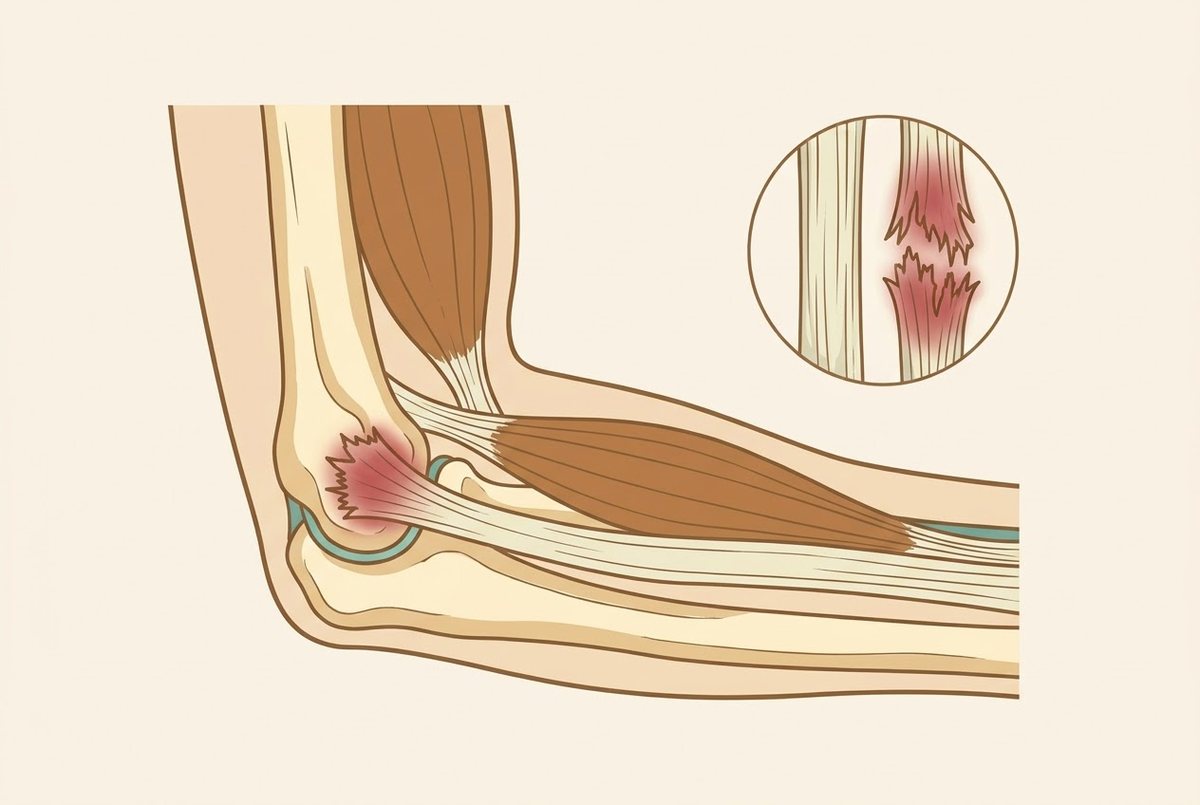
AAOS notes that treatment usually involves a team approach: primary care doctors, physical or occupational therapists and, in some cases, surgeons working together.
Causes and risk factors
Tendon overuse injuries develop when the load on the tendon is greater than it can adapt to. Common triggers include:
- Repetitive motions: gripping, wrist extension or flexion, and forearm rotation repeated for long periods, whether in racquet sports, golf, carpentry, painting, plumbing, cooking, typing or using tools
- A sudden increase in activity: new work tasks, a new sport, or a big change in training
- Age: tendons change with age and tolerate less load
- Technique and equipment: grip size, tool weight, workstation setup and movement patterns that overload the tendon
- Weak or tired supporting muscles in the forearm, shoulder and shoulder blade, which shifts load to the tendon
A physician or therapist looks for these factors, because treating the pain without changing the load often leads to recurrence.
Symptoms
- Pain and tenderness on the outside (tennis elbow) or inside (golfer’s elbow) of the elbow
- Pain that increases with gripping, lifting, shaking hands, turning a doorknob, or twisting a jar lid
- Weak grip and difficulty holding a cup or lifting a pan
- Stiffness or aching in the forearm after activity
- With bursitis: swelling or a soft lump over the point of the elbow, tenderness and sometimes warmth and redness
When to get help
- See your physician if elbow pain lasts more than a couple of weeks, keeps you from sleeping, or limits daily tasks.
- Seek care promptly for a hot, red, swollen elbow with fever, which can signal infection of a bursa or joint.
- Tell your doctor about numbness or tingling in the hand or ring and little fingers, since a nerve in the elbow can be affected too.
- A sudden pop with loss of strength after lifting needs evaluation for a tendon tear.
How tendon and elbow problems affect daily life
| What a person may notice | Why it happens | Who helps |
|---|---|---|
| Pain when lifting a cup, gripping a tool or shaking hands | The overloaded forearm tendons are stressed with each grip. | Occupational therapy, physical therapy |
| Pain at work with repeated tasks, such as typing, painting or cooking | Repetition without enough recovery overloads the same tendon. | Occupational therapy |
| Weak grip or dropping things | Pain inhibits the muscles and the tendon cannot transfer force well. | Physical therapy, occupational therapy |
| Pain that lingers after stopping the activity | Degenerated tendon tissue heals slowly and needs graded loading, not just rest. | Physical therapy |
| Trouble sleeping or using the arm for dressing and grooming | Pain with certain positions and movements limits everyday use. | Occupational therapy |
| A recurring problem that returns when you restart an activity | The underlying load, technique or strength deficit was never addressed. | Physical therapy, occupational therapy |
How care works
Overuse tendon problems usually respond to a combination of changes. Treatment may include modifying activities that aggravate the pain, anti-inflammatory medicine or other measures chosen by your physician, a supportive brace or strap when helpful, and a progressive exercise program for the forearm, elbow, shoulder and shoulder blade. Injections or surgery are considered if conservative care does not work, and your physician decides what is appropriate.
Research on physical therapy for lateral elbow tendinopathy, summarized in the Journal of Orthopaedic & Sports Physical Therapy, supports using evidence-based exercise and education to guide rehabilitation. A therapist tailors the program to your tendon, your activities and how irritable the problem is.
What occupational and physical therapy each do
Occupational therapy: changing how the load reaches the tendon
- Assessment of how you actually do work, hobby and home tasks, and which motions overload the tendon
- Changes to tools, grips, workstations and routines, and pacing of repetitive tasks
- Splint, strap or brace recommendations and training when helpful
- Joint protection and energy-saving techniques
- Hand and forearm strengthening that fits your daily tasks
Physical therapy: rebuilding tendon strength and control
- Assessment of the elbow, wrist, shoulder, shoulder blade and neck, since the whole arm shares load
- A graded loading program for the affected tendon, progressed as pain allows
- Strengthening of the forearm, shoulder and shoulder-blade muscles, and flexibility work
- Hands-on techniques and movement retraining as appropriate
- Return-to-sport or return-to-work progressions, and a written home program
Supporting services
What an ELEVATE home visit looks like
- Review: your symptoms, work, sport and hobbies, medicines and your doctors’ recommendations.
- Assessment: elbow, wrist, shoulder and neck motion and strength, grip, and how you perform your real tasks.
- Home and workstation setup: kitchen, tools, desk and keyboard.
- Plan: goals that matter to you and a written home program.
- Communication: progress shared with your physician as appropriate.
ELEVATE serves adults in Oakland and Macomb County, Michigan, with licensed occupational and physical therapists. See Payments & Insurance for details.
Questions families ask
Is tennis elbow only caused by tennis?
Should I rest completely?
Will a brace or strap help?
How long does it take to recover?
Is bursitis the same as tendinopathy?
Do I need a referral or does insurance cover this?
Does ELEVATE replace my doctor?
Trusted resources for elbow and tendon problems
These organizations are the leading sources of education and support for this condition. We are not affiliated with them.
Related guides
Browse every condition we treat on our Conditions We Treat page.
Sources and medical note
- American Academy of Orthopaedic Surgeons, OrthoInfo: Tennis Elbow (Lateral Epicondylitis) (reviewed by the American Shoulder and Elbow Surgeons).
- Physical Therapy for People with Lateral Elbow Tendinopathy: Using the Evidence to Guide Musculoskeletal Rehabilitation. Journal of Orthopaedic & Sports Physical Therapy, 2023.
- American Academy of Orthopaedic Surgeons, OrthoInfo: Rotator Cuff Tears (for the role of the bursa).
This page is educational and is not medical advice. It does not replace your physician’s care. Always follow your physician’s instructions. After an injury with severe pain, a deformed elbow or a cold, pale or blue hand, or for signs of stroke, call 911 immediately.
Contact Elevate Therapy Services
Need to reach us? Use our web form to send a message now, or contact us using one of the methods below.
We will be in contact within one to two business days.
Phone: (248) 266-5721
Fax: (586) 788-1704
