
Hand and Wrist Therapy at Home: Carpal Tunnel and Arthritis
In-Home Hand and Wrist Therapy in Oakland and Macomb County, Michigan
Restore grip, feeling, and fine control for the tasks you do every day.
ELEVATE provides in-home occupational and physical therapy for adults with carpal tunnel syndrome, hand and wrist arthritis, and recovery after hand injury or surgery in Oakland and Macomb County, Michigan. Licensed therapists work on hand function, joint protection, and daily tasks in your own home, alongside your physician or surgeon. Visits are private-pay and one-on-one.
- The hand and wrist depend on small bones, tendons and nerves working in tight spaces. Carpal tunnel syndrome, caused by pressure on the median nerve at the wrist, is one of the most common hand problems. Arthritis, tendon irritation and injuries are others.
- Typical signs are numbness, tingling or pain in the hand, nighttime symptoms, weak grip and trouble with fine tasks such as buttoning.
- Early treatment, such as night splinting, activity changes and nerve-gliding exercises, often relieves symptoms. If pressure on the nerve continues, it can cause permanent damage, so prompt evaluation matters.
- Occupational therapy restores hand function and protects the joints and nerves, and physical therapy addresses the neck and shoulder and overall movement.
- ELEVATE Therapy Services brings therapy to your home in Oakland and Macomb County, Michigan. Visits are private-pay and one-on-one.
How the hand and wrist work and what goes wrong
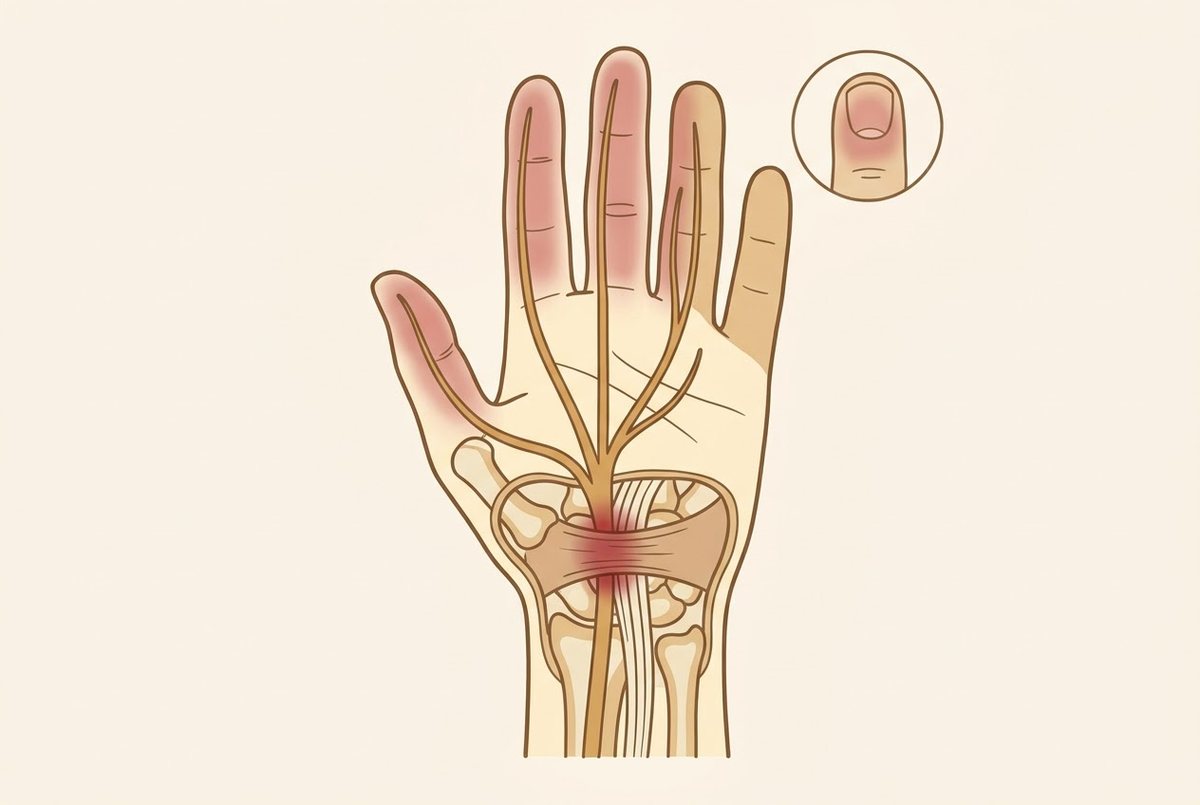
The American Academy of Orthopaedic Surgeons (AAOS) explains that the carpal tunnel is a narrow passageway in the wrist, about an inch wide. Its floor and sides are formed by small wrist bones (carpal bones), and its roof is a strong band of connective tissue called the transverse carpal ligament. Because these boundaries are rigid, the tunnel has little room to stretch. It contains the median nerve, which gives feeling to the thumb, index, middle and part of the ring finger, and the tendons that bend the fingers and thumb. In carpal tunnel syndrome, the median nerve is squeezed as it travels through the wrist.
Causes and risk factors
Carpal tunnel syndrome
AAOS notes that most cases are caused by a combination of factors. Women and older people are more likely to develop it. Other risk factors include:
- Heredity: the carpal tunnel may be naturally smaller in some people, and this can run in families
- Repetitive hand use: repeating the same motions over a long time can irritate the tendons and cause swelling that presses on the nerve
- Hand and wrist position: prolonged extreme bending or extension of the wrist raises pressure on the nerve
- Pregnancy: hormonal changes can cause swelling
- Health conditions: diabetes, rheumatoid arthritis and thyroid imbalance are associated with carpal tunnel syndrome
Hand and wrist arthritis
The National Institute of Arthritis and Musculoskeletal and Skin Diseases (NIAMS) explains that osteoarthritis is more common with age, affects women more often than men, and can follow joint injury. The hands, especially the ends of the fingers and the base and ends of the thumbs, are among the most commonly affected joints.
Symptoms
Carpal tunnel syndrome
- Numbness, tingling, burning and pain, mainly in the thumb and the index, middle and ring fingers, often waking people at night
- Occasional shock-like sensations in those fingers
- Pain or tingling that travels up the forearm
- Weakness and clumsiness, so fine tasks such as buttoning are hard, and dropping things
- Symptoms usually begin gradually, may come and go at first, and become more frequent or constant as the condition worsens
Hand arthritis
- Pain and stiffness in the finger and thumb joints, especially after rest
- Bony enlargements and changes in the shape of the finger joints
- Reduced grip strength and trouble with jars, keys, buttons and writing
When to get help
- See your physician promptly for numbness, tingling or weakness in the hand, especially if it wakes you at night or you are dropping things. AAOS stresses that carpal tunnel syndrome should be diagnosed and treated promptly, because untreated pressure can lead to permanent loss of sensation and weakness.
- Seek care for a hot, red, swollen joint with fever.
- Tell your doctor if numbness comes with neck pain or weakness in the arm, since the nerve can be irritated elsewhere.
How hand and wrist problems affect daily life
| What a person may notice | Why it happens | Who helps |
|---|---|---|
| Numbness or tingling that wakes you at night or shakes out in the morning | The median nerve is compressed in the wrist, especially when the wrist is bent during sleep. | Your physician, with occupational therapy |
| Dropping things or a weak grip | Nerve compression and joint pain reduce strength and the sense of where the hand is in space. | Occupational therapy |
| Trouble with buttons, writing, keyboards or phones | Fine motor control depends on healthy nerve signals and pain-free joints. | Occupational therapy |
| Aching, stiff or swollen finger and thumb joints | Arthritis changes the joint tissue and can cause bony enlargement. | Occupational therapy, your physician |
| Pain that spreads up the arm or into the neck | Nerves can be irritated at the neck, shoulder or wrist, sometimes in more than one place. | Physical therapy, with your physician |
| Difficulty with work tasks | Repetitive or forceful hand use and awkward wrist positions aggravate symptoms. | Occupational therapy |
How care works
If carpal tunnel syndrome is diagnosed and treated early, AAOS notes symptoms can often be relieved without surgery. Treatment can include wearing a splint at night to keep the wrist straight, anti-inflammatory medicine, changing activities and workstations that aggravate symptoms, nerve-gliding exercises, and sometimes a steroid injection into the carpal tunnel. If pressure on the nerve continues, surgery to relieve it may be recommended to prevent permanent damage.
For hand arthritis, NIAMS recommends learning about the condition, exercise to keep joints limber and muscles strong, and, when appropriate, braces or splints, medicines and surgery. The APTA clinical practice guideline on carpal tunnel syndrome supports individualized treatment including education, splinting, exercise and activity modification. After hand or wrist surgery, rehabilitation follows your surgeon’s protocol (see our post-surgical therapy guide).
What occupational and physical therapy each do
Occupational therapy: restoring hand function
- Assessment of grip, pinch, sensation, motion, swelling and how you do real tasks
- Splint recommendations and training, for example wrist positioning at night
- Nerve and tendon gliding exercises and hand strengthening and flexibility
- Joint protection and energy-saving techniques for arthritic hands
- Adaptive tools such as built-up handles, jar openers and key aids
- Workstation, keyboard and tool adjustments, and pacing strategies
- After injury or surgery: a program that follows your surgeon’s protocol
Physical therapy: the neck, shoulder and arm
- Assessment of the neck and shoulder, since nerves can be irritated at several points
- Posture, movement and nerve mobility strategies for the arm
- General strengthening and conditioning, and guidance on safe return to activity
Supporting services
What an ELEVATE home visit looks like
- Review: your symptoms, work and hobbies, medicines, your doctors’ recommendations and any surgeon’s protocol.
- Assessment: grip, pinch, sensation, motion and how you perform daily tasks.
- Home and workstation setup: kitchen, bathroom, keyboard and tools.
- Plan: goals that matter to you, a written home program and splint guidance.
- Communication: progress shared with your physician or surgeon as appropriate.
ELEVATE serves adults in Oakland and Macomb County, Michigan, with licensed occupational and physical therapists. See Payments & Insurance for details.
Questions families ask
Does carpal tunnel syndrome always need surgery?
Why are my symptoms worse at night?
Can computer work cause carpal tunnel syndrome?
Will exercise help arthritic hands?
How long should I wait before seeing a doctor?
Do I need a referral or does insurance cover this?
Does ELEVATE replace my doctor or hand surgeon?
Trusted resources for hand and wrist problems
These organizations are the leading sources of education and support for this condition. We are not affiliated with them.
Related guides
Browse every condition we treat on our Conditions We Treat page.
Sources and medical note
- American Academy of Orthopaedic Surgeons, OrthoInfo: Carpal Tunnel Syndrome.
- National Institute of Arthritis and Musculoskeletal and Skin Diseases: Osteoarthritis and Osteoarthritis: Diagnosis, Treatment, and Steps to Take.
- Erickson M et al. Hand Pain and Sensory Deficits: Carpal Tunnel Syndrome. Journal of Orthopaedic & Sports Physical Therapy, 2019 (APTA).
- American Society for Surgery of the Hand: HandCare (patient information and find a hand surgeon).
This page is educational and is not medical advice. It does not replace your physician’s or hand surgeon’s care. Always follow your physician’s instructions. After an injury with severe pain, a deformed hand or wrist, or a cold, pale or blue hand, or for signs of stroke, call 911 immediately.
Contact Elevate Therapy Services
Need to reach us? Use our web form to send a message now, or contact us using one of the methods below.
We will be in contact within one to two business days.
Phone: (248) 266-5721
Fax: (586) 788-1704
