
Speech and Voice Disorders Therapy at Home: Apraxia, Dysarthria and Voice Problems
In-Home Speech and Voice Therapy in Oakland and Macomb County, Michigan
Clearer speech and a healthier voice, practiced where you live.
ELEVATE provides in-home speech-language therapy for adults with apraxia of speech, dysarthria, and voice problems in Oakland and Macomb County, Michigan. Licensed speech-language pathologists work on speech clarity, volume, voice, and communication in your own home, alongside your physician. Visits are private-pay and one-on-one.
- Clear speech takes planning in the brain, strength and coordination in the muscles of the lips, tongue, jaw and breathing, and a healthy voice box. A problem at any of these points can change how someone sounds.
- Apraxia of speech is a problem of planning the movements of speech. Dysarthria is slurred or weak speech from muscle problems after brain or nerve damage. Voice disorders change pitch, volume or quality, such as hoarseness.
- Sudden changes in speech need 911 right away. Voice changes lasting more than a couple of weeks need a physician’s evaluation.
- Speech-language pathologists evaluate and treat all three, and work with your physician and, for voice problems, an ear, nose and throat doctor.
- ELEVATE Therapy Services brings speech-language therapy to your home in Oakland and Macomb County, Michigan. Visits are private-pay and one-on-one.
How speech and voice work and what goes wrong
Speaking is one of the most complex things the body does. The brain plans which sounds to make and in what order. Nerves send those instructions to muscles in the face, lips, tongue, jaw and throat, and to the muscles used for breathing. The vocal folds in the voice box (larynx) vibrate as air passes, creating voice, and the throat, nose and mouth shape the sound.
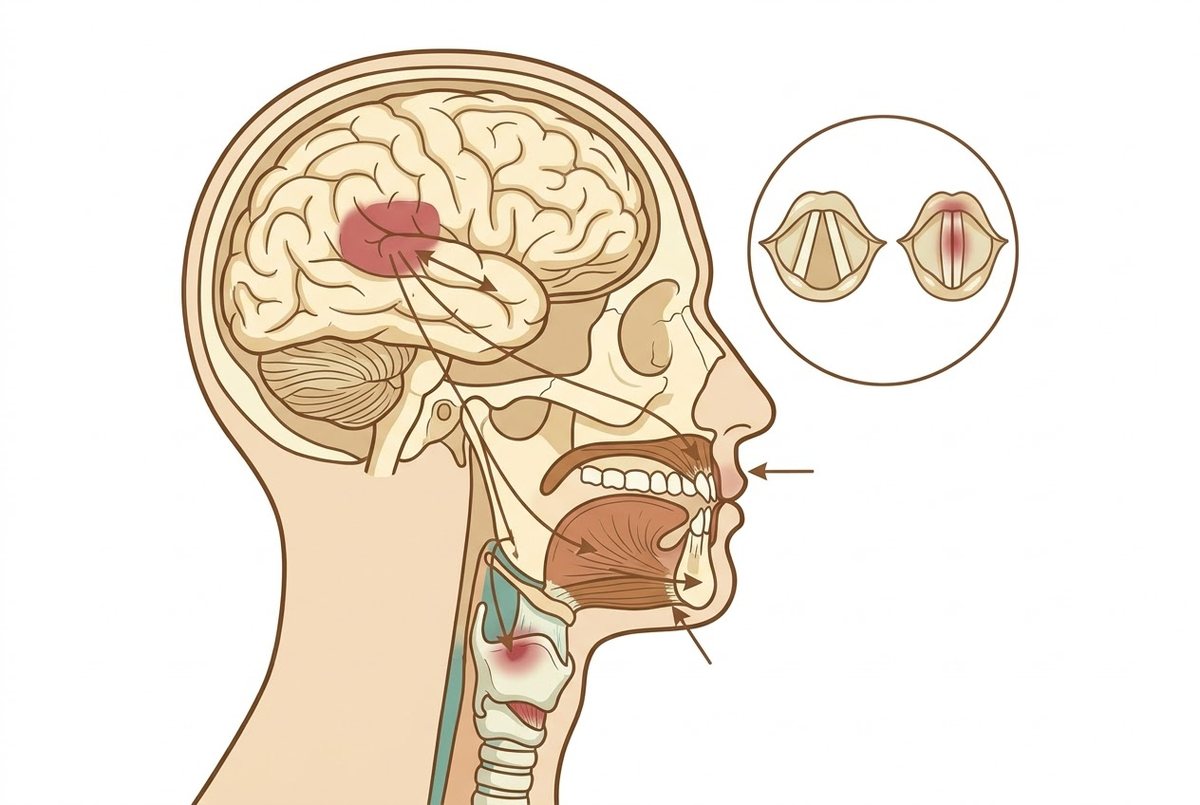
Some people have more than one of these problems, or have aphasia as well, which is a language problem rather than a speech problem. See our stroke guide for aphasia.
Causes and risk factors
Apraxia of speech and dysarthria
Acquired apraxia of speech is caused by damage to the parts of the brain involved in speaking, and can result from a stroke, head injury, tumor or other illness affecting the brain. It most typically occurs in adults. Dysarthria can follow anything that damages the brain or nerves. Examples include:
- Stroke and brain injury
- Parkinson’s disease and multiple sclerosis
- Amyotrophic lateral sclerosis (ALS), Huntington’s disease, cerebral palsy and muscular dystrophy
- Spinal cord injury and tumors
Voice problems
NIDCD lists these causes of voice problems:
- Upper respiratory infections
- Inflammation from acid reflux (GERD)
- Vocal misuse and overuse, which is common in teachers, singers and others who talk for a living
- Growths on the vocal folds, such as nodules, and cancer of the larynx
- Neurological conditions such as spasmodic dysphonia or vocal fold paralysis
- Psychological trauma
Signs and symptoms
Apraxia of speech
- Distorted sounds, especially vowels, and more trouble with longer or more complex words
- Inconsistent errors: a word may be said correctly once and then be hard to repeat
- Groping for the right sound or word, and trying several times
- Unusual rhythm, stress or pauses
Dysarthria
- Slurred, mumbled, too slow or too fast speech
- Speech that is too quiet or too loud, or sounds choppy, hoarse or breathy
- Trouble moving the tongue, lips and jaw
- Speech that sounds different from before and is hard for others to understand
Voice problems
- A hoarse or raspy voice, or a voice that suddenly sounds deeper
- A throat that often feels raw, achy or strained
- Talking becomes an effort, or you clear your throat repeatedly
- Losing the ability to hit certain notes when singing
When to get help
- See a doctor right away for any new difficulty talking.
- See a physician for hoarseness or a voice change that lasts more than a couple of weeks, especially if you smoke, since an ear, nose and throat specialist (otolaryngologist) can check the voice box.
- Report trouble swallowing, coughing with meals or breathing difficulty to your physician, since speech and swallowing problems often occur together.
- Tell your neurologist if speech worsens over time.
How speech and voice problems affect daily life
| What a person may notice | Why it happens | Who helps |
|---|---|---|
| Knowing what to say but struggling to get the sounds out | In apraxia of speech the brain cannot plan and sequence the movements needed for speech. | Speech-language pathology |
| People cannot understand you or ask you to repeat | Weak or poorly coordinated speech muscles in dysarthria blur speech sounds. | Speech-language pathology |
| Speech is too quiet or tires quickly | Weak breath support and weak muscles reduce volume and stamina, common in Parkinson’s disease. | Speech-language pathology |
| A hoarse voice or an effortful, strained voice | The vocal folds are irritated, overused, swollen or not closing well. | Your physician and otolaryngologist, with speech-language pathology |
| Avoiding phone calls, groups or restaurants | Fear of not being understood leads to withdrawal. | Speech-language pathology, with family |
| Frustration and fatigue | Communicating takes much more effort. | Whole team, with your physician |
How speech and voice are evaluated
A physician, often a neurologist or an otolaryngologist, looks for the cause. A speech-language pathologist (SLP) then assesses how you move your mouth, lips and tongue, how well you breathe, and how you sound, and listens to your speech and voice in words, sentences and conversation. For apraxia, the SLP may ask you to repeat words or lists of words of increasing length, such as love, loving, lovingly. There is no single test for apraxia, so the SLP looks for a group of symptoms and rules out other conditions such as muscle weakness and aphasia.
For voice problems, an otolaryngologist examines the larynx first, and may then refer you to an SLP to help you improve the way you use your voice.
How care works
NIDCD notes that some people with acquired apraxia of speech recover some or all of their speech on their own, called spontaneous recovery, but speech-language therapy is needed for those who do not. For dysarthria, therapy depends on the type and severity and may focus on slowing down, speaking more loudly, moving the lips and tongue more fully, saying sounds clearly in words and sentences, and improving breathing to support clear, louder speech. NIDCD adds that most voice problems can be reversed by treating the underlying cause, or through behavioral and sometimes surgical treatments.
When speech cannot meet communication needs, speech-language pathologists can also introduce augmentative and alternative communication (AAC), such as picture boards, writing or devices, alongside therapy.
What speech-language pathology does
Speech-language pathology: what happens in therapy
- A thorough evaluation of speech, voice, language and swallowing
- Exercises matched to your type of speech disorder, with a written home practice program
- Strategies for being understood: slowing down, speaking up, breaking sentences into chunks and using gestures or writing
- Voice care: hydration, vocal rest, reducing strain and managing reflux triggers with your physician
- Family and caregiver training on how to listen, cue and support communication
- Referral to your physician or an otolaryngologist when findings suggest a medical problem
Supporting services
What an ELEVATE home visit looks like
- Review: how your speech or voice has changed, medicines and your doctors’ recommendations.
- Assessment: mouth, lip and tongue movement, breath support, speech and voice in conversation.
- Home practice: exercises and strategies you can do between visits, and family coaching.
- Plan: goals that matter to you, such as phone calls, groups and work.
- Communication: progress shared with your physician, with referral for further evaluation when needed.
ELEVATE serves adults in Oakland and Macomb County, Michigan, with licensed speech-language, occupational and physical therapists. See Payments & Insurance for details.
Questions families ask
What is the difference between apraxia and dysarthria?
Can apraxia of speech get better?
Why is my voice hoarse?
What if I cannot be understood on the phone?
Is slurred speech always an emergency?
Do I need a referral or does insurance cover this?
Does ELEVATE replace my doctor or neurologist?
Trusted resources for speech and voice problems
These organizations are the leading sources of education and support for this condition. We are not affiliated with them.
Related guides
Browse every condition we treat on our Conditions We Treat page.
Sources and medical note
- National Institute on Deafness and Other Communication Disorders: What Is Apraxia of Speech? and Taking Care of Your Voice.
- Communication Health Support Association: Dysarthria (patient information from the speech-language pathology profession).
This page is educational and is not medical advice. It does not replace your physician’s care. Always follow your physician’s and speech-language pathologist’s instructions. For sudden slurred speech, trouble speaking or understanding, face drooping or arm weakness, call 911 immediately.
Contact Elevate Therapy Services
Need to reach us? Use our web form to send a message now, or contact us using one of the methods below.
We will be in contact within one to two business days.
Phone: (248) 266-5721
Fax: (586) 788-1704
