
Stroke and Neurological Rehabilitation at Home
In-Home Neuro Rehab in Oakland and Macomb County, Michigan
Physical, occupational, and speech therapy built around how you move, think, and communicate.
ELEVATE provides in-home rehabilitation for adults recovering from stroke or living with neurological conditions such as Parkinson's disease, multiple sclerosis, or brain injury in Oakland and Macomb County, Michigan. Licensed physical, occupational, and speech-language therapists work on walking, balance, daily tasks, speech, and swallowing in your own home. Visits are private-pay and one-on-one.
- A stroke happens when blood flow to part of the brain is blocked (ischemic stroke) or a blood vessel in the brain bursts (hemorrhagic stroke). Brain cells in the affected area are damaged.
- Sudden weakness, face drooping, trouble speaking, vision or balance loss need 911 right away. Use BE FAST to remember the signs.
- What a person notices afterward depends on which part of the brain was affected: movement, balance, vision, speech, swallowing, thinking and daily self-care can all change.
- Rehabilitation is a team effort. Physical therapy works on moving and walking, occupational therapy on daily activities and arm and hand use, and speech-language pathology on communication, thinking and swallowing.
- ELEVATE Therapy Services brings these therapies to your home in Oakland and Macomb County, Michigan. Visits are private-pay and one-on-one.
What a stroke is
Your brain controls movement, memory, emotion, language and many automatic body functions. To do that work it needs a steady supply of oxygen-rich blood. A stroke, sometimes called a “brain attack,” happens when that supply is cut off or when a blood vessel in the brain ruptures. Within minutes, the brain cells that lose their blood supply begin to die, which is why fast treatment matters so much.
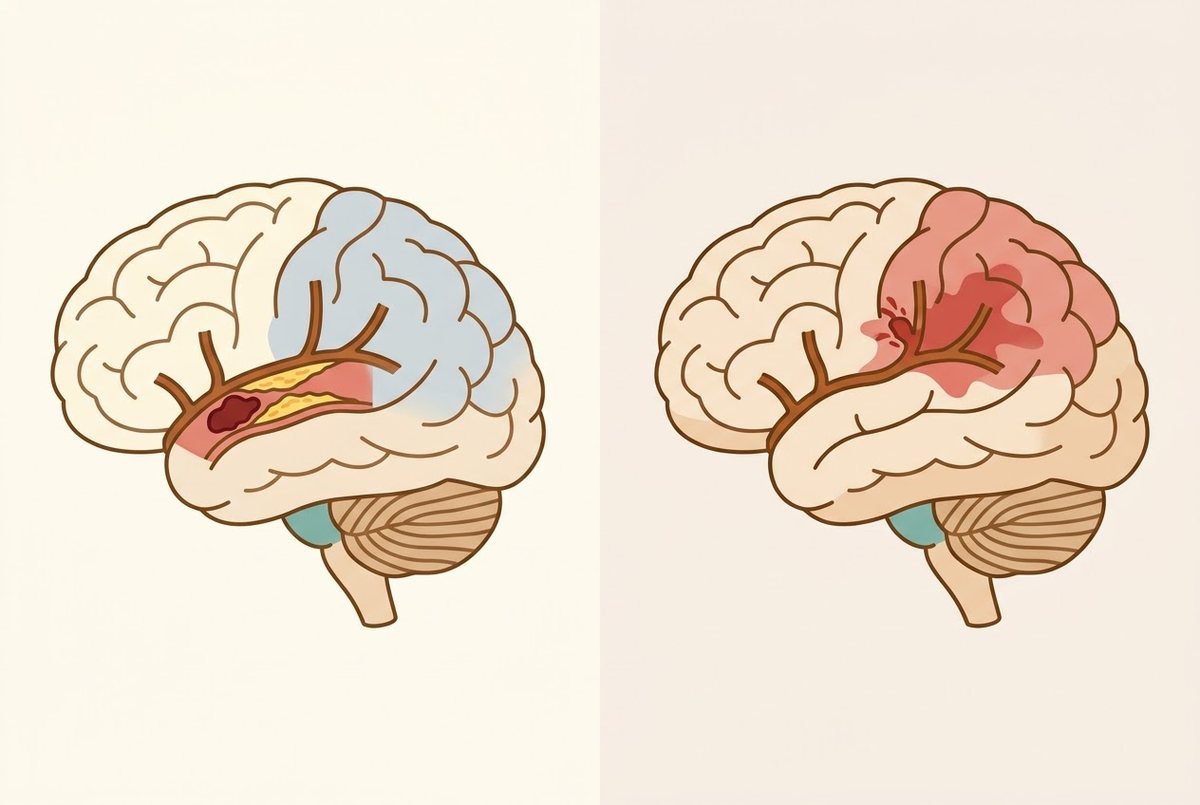
There are two main types of stroke, plus a related warning event.
Both types damage brain tissue. The location and size of the damage, not just the type of stroke, shape what a person can and cannot do afterward, and that in turn decides what rehabilitation needs to focus on.
What causes a stroke and who is at risk
A stroke is the end result of something going wrong with the brain’s blood vessels, and it usually has an underlying cause that can be found and managed. Understanding the cause matters to rehabilitation because the same conditions that led to a first stroke often affect how hard a person can exercise and what warning signs the therapist watches for.
How a blockage forms
- Atherosclerosis: fatty plaque narrows the arteries in the neck or brain, and clots can form on the roughened surface.
- Clots from the heart: an irregular heartbeat such as atrial fibrillation, or other heart conditions, can let clots form and travel to the brain.
- Small-vessel disease: long-term high blood pressure or diabetes can damage the smallest blood vessels deep in the brain.
How a bleed happens
- Uncontrolled high blood pressure can weaken and rupture vessels. It is one of the leading causes of stroke overall.
- Aneurysms or malformed vessels can burst without warning.
- Blood-thinning medicines can increase bleeding risk, which is why your doctor monitors them closely.
Risk factors
Many of these risk factors can be managed with your health care team. If you have had a stroke, a plan for blood pressure, cholesterol, blood sugar, activity and nutrition is a major part of preventing another one. Your therapists support that plan but do not replace your doctor’s care.
Warning signs: BE FAST
The American Stroke Association teaches the BE FAST signs. Any one of them that appears suddenly is a reason to call 911 immediately, even if it seems to go away.
- B – Balance: sudden loss of balance or coordination, trouble walking, or dizziness.
- E – Eyes: sudden blurred or double vision, or loss of sight in one or both eyes.
- F – Face: one side of the face droops or feels numb. Ask the person to smile.
- A – Arm: one arm is weak or numb. Ask the person to raise both arms; one may drift down.
- S – Speech: slurred or hard-to-understand speech, or trouble understanding others.
- T – Time: call 911 right away and note the time symptoms started.
How a stroke affects the body and daily life
Each part of the brain has a job, so the effects of a stroke follow the area that was damaged. Because the brain’s movement and sensation pathways cross over, a stroke on one side of the brain most often affects the opposite side of the body. Language functions are usually based in the left side of the brain. Two people with the same type of stroke can look very different, which is why rehabilitation begins with a careful assessment.
| What a person may notice | Why it happens | Who helps |
|---|---|---|
| Weakness or paralysis on one side | Damage to the brain’s movement pathways reduces the signals reaching the muscles. Muscles may also become stiff or tight (spasticity). | Physical therapy, occupational therapy |
| Trouble with balance and walking | Weakness, changed muscle tone, reduced coordination and reduced sensation in the leg and foot make steady walking harder and raise fall risk. | Physical therapy |
| A weak or clumsy arm and hand | The arm and hand need fine control from the brain. Reaching, gripping and letting go can all change, and the shoulder can become painful. | Occupational therapy, physical therapy |
| Difficulty with dressing, bathing, cooking or toileting | Weakness, vision changes, attention and planning problems combine to make everyday routines harder. | Occupational therapy |
| Trouble finding words or understanding others (aphasia) | Damage to language areas, most often on the left side, affects speaking, understanding, reading and writing, while intelligence is unchanged. | Speech-language pathology |
| Slurred or weak speech, or a hard-to-control voice | Weakness or poor coordination of the muscles used for speaking. | Speech-language pathology |
| Coughing or choking when eating or drinking (dysphagia) | Weakened or poorly timed swallowing muscles can let food or liquid go down the wrong way. | Speech-language pathology, with a dietitian |
| Memory, attention, planning or awareness problems | Damage to the networks that handle thinking can make it hard to follow steps, stay focused, or notice one side of the body or space. | Occupational therapy, speech-language pathology |
| Fatigue and mood changes | The brain works harder after injury, and mood changes including depression are common after stroke. Tell your doctor if these affect recovery. | Whole team, with your physician |
How stroke recovery works
The brain has a limited ability to reorganize itself after injury, called neuroplasticity. Rehabilitation takes advantage of it with repeated, purposeful, task-specific practice that gets gradually harder as the person improves. Rehabilitation guidelines from the American Heart Association and American Stroke Association call for care that is coordinated by a team and tailored to the individual. Recovery looks different for every person, and no one can promise how much function will return.
Most people start rehabilitation in the hospital as soon as they are medically stable. After that, therapy may continue in an inpatient rehabilitation unit, a skilled nursing facility, an outpatient clinic or the home. The path is rarely a straight line, and many people move between settings.
Practice at home matters because the goal of rehabilitation is to do things in real life: walking from the bedroom to the kitchen, getting in and out of the shower, climbing the front steps, holding a conversation with family. When therapy takes place where those activities happen, the therapist can work on the actual stairs, bathroom and furniture and train the people who help every day.
What physical, occupational and speech therapy each do
These three therapies overlap and work best together. Here is how each one connects to what a stroke changes.
Physical therapy: getting people moving safely again
After a stroke, the legs may be weak, muscle tone may be abnormally high or low, and the brain may receive less accurate information about where the body is in space. A physical therapist assesses strength, balance, walking and transfers (such as moving from bed to chair) and builds a plan around the person’s goals.
- Task-specific practice such as standing up, stepping, turning and climbing stairs, repeated and progressed over time
- Strengthening and balance training matched to what the person can safely do
- Gait training and recommendations for walkers, canes or braces when appropriate
- Aerobic conditioning as cleared by the physician
- Fall-risk screening, plus training for family members on how to help safely
Occupational therapy: getting back to the activities of daily life
Occupational therapists look at how a person actually performs the routines that fill the day and at the home where they take place. They work on dressing, bathing, grooming, toileting, meal preparation and other routines. They also work on arm and hand use, and on the vision, attention and planning skills those tasks require.
- Retraining the arm and hand for reaching, gripping and fine movements
- Teaching one-handed or adapted ways to do tasks when needed
- Strategies for vision, attention, memory and sequencing problems that interfere with daily tasks
- Bathroom, bedroom and kitchen setup, and equipment recommendations
- Energy conservation and pacing for fatigue
Speech-language pathology: communication, thinking and swallowing
Speech-language pathologists evaluate and treat problems with speech, language, cognition and swallowing. Aphasia, apraxia of speech (trouble planning the movements of speech), dysarthria (weak or uncoordinated speech muscles) and cognitive-communication problems each call for a different approach.
- Language therapy for finding words, understanding, reading and writing
- Speech exercises and strategies to make speech clearer
- Cognitive-communication work on attention, memory and problem solving in everyday conversations
- Swallowing evaluation and therapy, with safe-eating strategies and food and liquid texture recommendations
- Coaching family and caregivers on how to communicate effectively
If a swallowing problem needs a detailed look, the therapist can recommend further testing with your physician, such as an imaging study done at a hospital or clinic.
Supporting services that can fit around core rehabilitation
Once the core therapies are underway and your doctor agrees, other services can support recovery and long-term health. They complement rehabilitation and do not replace it.
Other neurological conditions
The same team approach applies to other conditions that affect the brain and nervous system. People with Parkinson’s disease, multiple sclerosis and brain injury may also need help with movement, balance, daily tasks, speech and swallowing. Physical therapy guidelines for Parkinson’s disease support exercise-based approaches such as strengthening, balance and gait training. Each condition has its own pattern and course, so care is individualized, and your neurologist or physician remains in charge of your medical management.
What an ELEVATE home visit looks like
- Review: your medical history and your doctors’ recommendations.
- Assessment: how you move, balance and manage daily tasks, with speech, language, thinking and swallowing screening when needed.
- Home setup: entrances, stairs, bathroom, kitchen, lighting and fall hazards.
- Plan: goals that matter to you, a written home program, and training for family and caregivers.
- Communication: progress shared with your physician as appropriate.
ELEVATE serves adults in Oakland and Macomb County, Michigan, with licensed physical, occupational and speech-language therapists. Visits are private-pay and one-on-one. See Payments & Insurance for details.
Questions families ask
How soon after a stroke should rehabilitation start?
Can people keep improving long after the stroke?
What is the difference between PT, OT and speech therapy?
Is therapy at home different from therapy in a clinic?
What should family members do if they see stroke signs?
What if swallowing seems unsafe?
Do I need a referral or does insurance cover this?
Does ELEVATE replace my doctor or other therapy?
Trusted resources for stroke and neurological conditions
These organizations are the leading sources of education and support for this condition. We are not affiliated with them.
Related guides
Browse every condition we treat on our Conditions We Treat page.
Sources and medical note
- Centers for Disease Control and Prevention: About Stroke and Risk Factors for Stroke.
- American Stroke Association: Stroke Symptoms and Warning Signs (BE FAST).
- Winstein CJ et al. Guidelines for Adult Stroke Rehabilitation and Recovery. Stroke, 2016 (AHA/ASA).
- Communication Health Support Association: Aphasia.
- Osborne JA et al. Physical Therapist Management of Parkinson Disease: A Clinical Practice Guideline. Physical Therapy, 2022 (APTA).
- American Stroke Association: Help and Support (support groups and caregiver resources).
This page is educational and is not medical advice. It does not replace your physician’s care. Always follow your physician’s instructions. For sudden face drooping, arm weakness, trouble speaking, vision or balance loss, or a severe headache, call 911 immediately.
Contact Elevate Therapy Services
Need to reach us? Use our web form to send a message now, or contact us using one of the methods below.
We will be in contact within one to two business days.
Phone: (248) 266-5721
Fax: (586) 788-1704
