
Hip Pain, FAI and Labral Tear Therapy at Home
In-Home Hip Therapy in Oakland and Macomb County, Michigan
Move your hip freely again, with strength and control for the activities you love.
ELEVATE provides in-home physical and occupational therapy for adults with femoroacetabular impingement (FAI), labral tears, hip bursitis, and other hip pain in Oakland and Macomb County, Michigan. Licensed therapists work on motion, strength, movement, and daily tasks in your own home, alongside your physician or surgeon. Visits are private-pay and one-on-one.
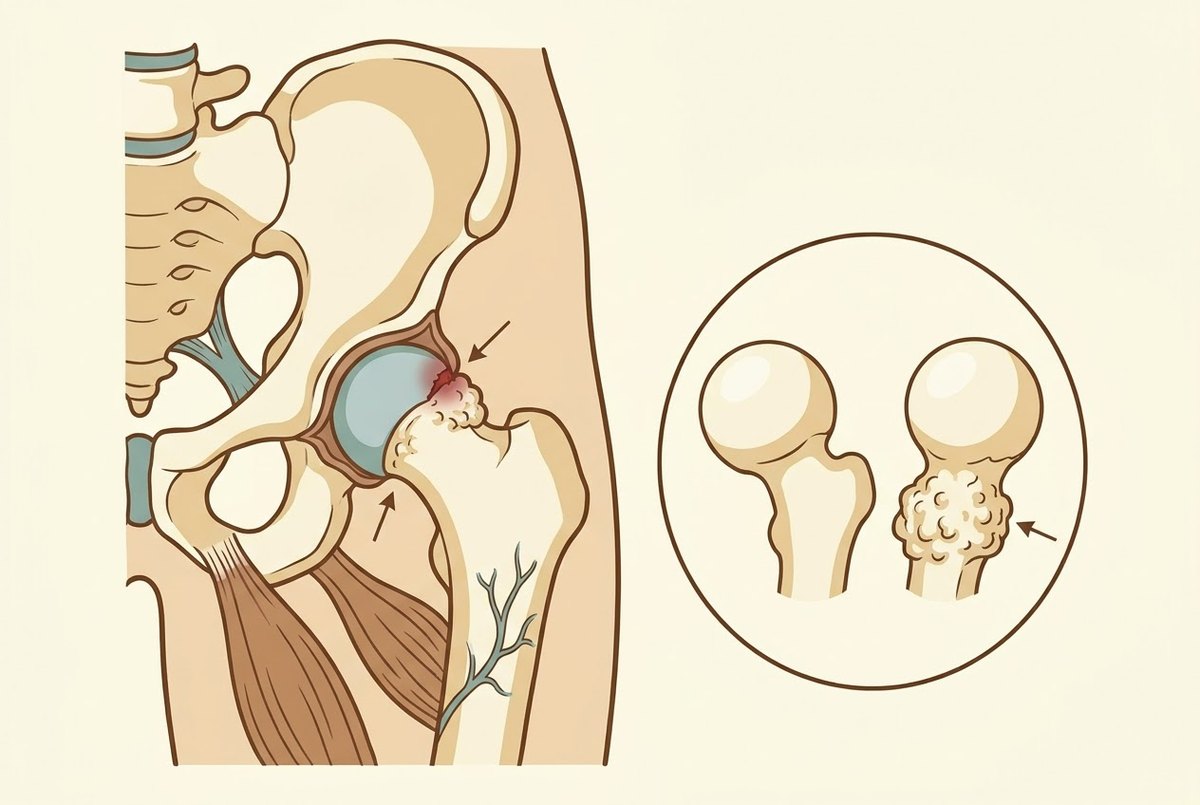
- The hip is a ball-and-socket joint ringed by a rim of cartilage called the labrum. When the bones of the ball or socket are shaped abnormally, they can pinch the labrum and damage cartilage, a condition called femoroacetabular impingement (FAI).
- Hip and groin pain with turning, twisting and squatting, stiffness and limping are typical signs. Labral tears, bursitis around the outside of the hip and hip arthritis are other common causes of hip pain.
- Many hip problems are managed without surgery, and rehabilitation is central whether or not surgery is chosen.
- Physical therapy restores motion, strength and movement control, and occupational therapy helps with daily tasks, positioning and home setup.
- ELEVATE Therapy Services brings therapy to your home in Oakland and Macomb County, Michigan. Visits are private-pay and one-on-one.
How the hip works and what goes wrong
The American Academy of Orthopaedic Surgeons (AAOS) describes the hip as a ball-and-socket joint. The socket is the acetabulum, part of the pelvis, and the ball is the femoral head, the top of the thighbone. Smooth, slippery articular cartilage covers the ball and socket so the bones glide easily. The acetabulum is ringed by strong fibrocartilage called the labrum, which forms a gasket around the socket, creating a tight seal and helping stabilize the joint. In a healthy hip, the ball fits perfectly in the socket.
Causes and risk factors
FAI
AAOS explains that there are three types of FAI. In pincer impingement, extra bone extends over the normal rim of the socket, and the labrum can be crushed. In cam impingement, the ball is not round and cannot rotate smoothly, and a bump on the edge of the femoral head grinds the cartilage inside the socket. Combined impingement has both. FAI occurs because the hip bones do not form normally during the childhood growing years, or because of bone overgrowth (bone spurs). When the hip bones are shaped abnormally, there is little that can be done to prevent FAI.
AAOS adds that it is not known how many people have FAI, and some people live long, active lives with it and never have problems. Athletic people may feel pain earlier because they work the hip joint harder, but exercise does not cause FAI. When symptoms develop, it usually indicates that there is damage to the cartilage or labrum.
Other causes of hip pain
- Overuse of the hip muscles and tendons, especially with a sudden increase in activity
- Hip osteoarthritis, which becomes more common with age
- Injury, such as a fall or a twisting sports injury
- Weakness of the hip and core muscles that changes how the hip moves
Symptoms
AAOS lists the most common symptoms of FAI as pain, stiffness and limping. Pain often occurs in the groin, although it may occur toward the outside of the hip. Turning, twisting and squatting may cause a sharp, stabbing pain, and sometimes the pain is just a dull ache.
- Groin or outer hip pain that is worse with pivoting, deep squats, prolonged sitting or getting out of a car
- Stiffness and reduced hip motion
- A limp, or trouble putting on shoes and socks
- Catching, clicking or a locking sensation with a labral tear
- Pain on the outside of the hip that is worse lying on that side, with bursitis
When to get help
- See your physician for hip or groin pain that lasts more than a few weeks, limits walking or sleep, or comes with locking or giving way.
- Get care promptly for a hot, red, swollen hip with fever, or for new groin pain with a limp in someone with a hip replacement.
- Calf pain, swelling, warmth or redness after hip surgery can signal a blood clot and needs urgent attention.
- Report pain that is worsening despite rest, so the cause can be identified.
How hip problems affect daily life
| What a person may notice | Why it happens | Who helps |
|---|---|---|
| Groin pain with deep squats, pivoting or sitting for long | The ball and socket pinch together at the end of motion, irritating the labrum and cartilage. | Physical therapy, with your physician |
| Stiff hip and trouble putting on socks, shoes or getting out of a car | Bone shape and tightness limit hip bending and rotation. | Physical therapy, occupational therapy |
| A limp or shorter stride | Pain makes the muscles guard the joint and changes how you walk. | Physical therapy |
| Pain on the outside of the hip when lying on it or climbing stairs | An irritated bursa or the hip tendons are compressed or overloaded. | Physical therapy |
| Catching or a feeling that the hip gives way | A torn labrum can catch in the joint, and weak hip muscles reduce control. | Your physician, with physical therapy |
| Giving up sport, walking or hobbies | Pain with activity leads to avoiding movement. | Physical therapy |
How care works
Treatment depends on the cause and on how much the hip is limiting you. AAOS describes initial steps for FAI such as identifying and modifying the activities that provoke pain, and notes that surgery, such as hip arthroscopy, is an option when conservative care does not help or when there is significant damage. Your physician decides whether surgery is advisable, taking into account your age, activity level and imaging findings.
The APTA clinical practice guideline on hip pain and mobility deficits (hip osteoarthritis) supports education, exercise, and, when appropriate, manual therapy and walking aids. Similar principles apply across many hip conditions: strengthen the muscles around the hip and trunk, restore motion within a comfortable range, and improve how the hip moves in daily tasks and sport. After hip surgery, rehabilitation follows your surgeon’s protocol (see our post-surgical therapy guide).
What physical and occupational therapy each do
Physical therapy: a stronger, better-moving hip
- Assessment of hip motion, strength, pelvic and core control, and movement during walking, squatting and sport
- Strengthening of the glutes, hip rotators, thigh and trunk muscles, progressed as pain allows
- Motion work within a comfortable range and advice on positions and activities that irritate the joint
- Movement retraining for squatting, stairs, running and pivoting
- Return-to-sport progressions with your physician’s clearance, and a written home program
- After surgery: a stepwise program following your surgeon’s protocol
Occupational therapy: making daily tasks easier
- Safe ways to dress, put on shoes and socks, bathe and get in and out of a car or bed
- Equipment such as a sock aid, long-handled reacher or raised toilet seat when needed
- Home and workstation setup to reduce deep hip bending
- Pacing strategies for walking and standing
- Training for family members who help
Supporting services
What an ELEVATE home visit looks like
- Review: where and when the hip hurts, activity history, medicines and your doctors’ recommendations, including any surgeon’s protocol.
- Assessment: hip motion, strength, pelvic and core control, walking and daily tasks.
- Home setup: chairs, bed, car transfers, stairs and bathroom.
- Plan: goals that matter to you and a written home program.
- Communication: progress shared with your physician or surgeon as appropriate.
ELEVATE serves adults in Oakland and Macomb County, Michigan, with licensed physical and occupational therapists. See Payments & Insurance for details.
Questions families ask
What is femoroacetabular impingement?
Does exercise cause FAI?
Do I need surgery for FAI or a labral tear?
Is it safe to exercise with hip pain?
Can hip bursitis be treated with therapy?
Do I need a referral or does insurance cover this?
Does ELEVATE replace my doctor or surgeon?
Trusted resources for hip problems
These organizations are the leading sources of education and support for this condition. We are not affiliated with them.
Related guides
Browse every condition we treat on our Conditions We Treat page.
Sources and medical note
- American Academy of Orthopaedic Surgeons, OrthoInfo: Femoroacetabular Impingement.
- Cibulka MT et al. Hip Pain and Mobility Deficits: Hip Osteoarthritis: Revision 2017. Journal of Orthopaedic & Sports Physical Therapy, 2017 (APTA).
- Arthritis Foundation: Osteoarthritis.
This page is educational and is not medical advice. It does not replace your physician’s or surgeon’s care. Always follow your physician’s instructions. After a fall with severe hip or groin pain, a leg that looks shortened or turned out, or if you cannot bear weight, call 911 immediately.
Contact Elevate Therapy Services
Need to reach us? Use our web form to send a message now, or contact us using one of the methods below.
We will be in contact within one to two business days.
Phone: (248) 266-5721
Fax: (586) 788-1704
