

Parents notice posture long before anyone names it: a baby who always turns her head one way, a toddler who walks on his toes, a pant hem that hangs unevenly, a shoulder blade that sticks out when a teenager bends forward. Most of these are normal variations. A few respond best to early attention, and some appear alongside developmental delay.
This guide reviews what the research shows about when early physical therapy makes a measurable difference, when watchful waiting is the better plan, and what to ask your child’s physician.
The short version
- Early is not always better. The evidence for acting early is strongest for torticollis, more limited for exercise in scoliosis, and for most normal variations the best plan is to watch and recheck. 1
- Torticollis: physical therapy started before 3 to 4 months is associated with excellent outcomes, and starting earlier shortens treatment and reduces the need for surgery. 2
- Scoliosis: early detection matters because bracing during growth kept more high-risk curves below the surgical threshold (72 percent versus 48 percent with observation). Bracing is managed by the physician, and high-quality evidence for exercise alone is lacking. 3, 4
- Clumsiness and injury risk: leg length differences, scoliosis, and torticollis can affect walking, balance, or early motor skills, but findings are mixed and much of the injury research comes from adults. 5, 6, 7
- About 1 in 6 U.S. children ages 3 to 17 has a developmental delay, disorder, or disability of some kind, so asking early is reasonable. 8
In this guide
- Normal variation or something more?
- Torticollis and flat head in babies
- Toe walking and common normal variations
- Leg length discrepancy: structural and functional
- Scoliosis: structural and functional
- Posture, clumsiness, and injury risk: what the research shows
- Developmental delay and early intervention
- What a physical therapy evaluation involves
- Do you need a physician referral in Michigan?
- Questions parents ask
- For referring clinicians
- Next steps
Normal variation or something more?
Most lower-limb concerns parents raise, including in-toeing, out-toeing, bow legs, knock knees, and flexible flat feet, are normal variations of growth. Findings within the normal range tend to resolve as a child grows, X-rays are not routinely needed, and orthotics have not been shown to help. 1
What raises the level of concern is a pattern: asymmetry (one side different from the other), a finding that is getting worse, pain, a skill your child had and lost, or posture changes that come with delayed milestones.
Torticollis and flat head in babies
Congenital muscular torticollis (CMT) is a postural asymmetry present at or shortly after birth. A tight, shortened neck muscle tilts the head to one side and turns the face to the other. 9 Reported rates vary widely between studies, and CMT is considered the third most common congenital musculoskeletal condition in newborns. 10
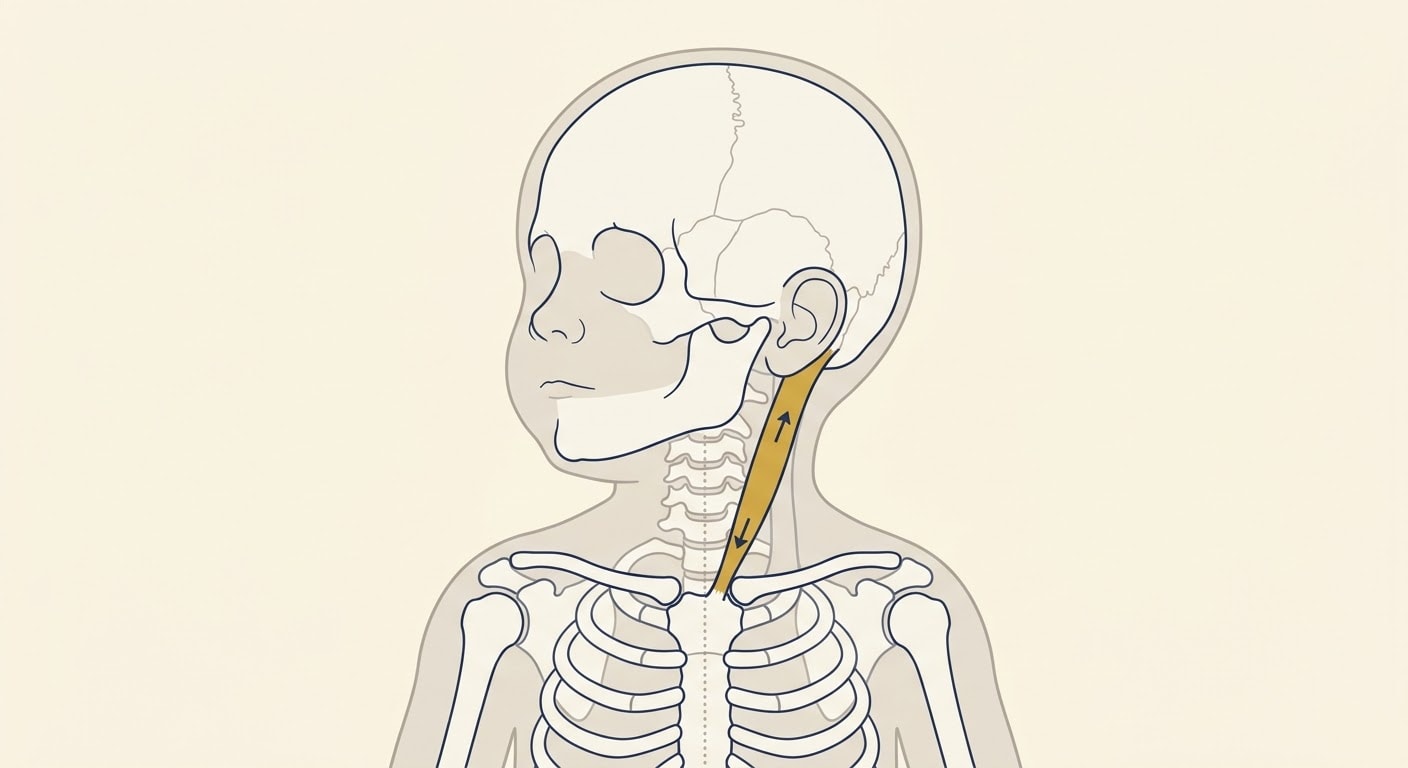
What the evidence says about starting early:
- The APTA’s 2018 clinical practice guideline recommends screening all infants from birth through six months 11 and referring to a physical therapist as soon as asymmetry is noticed. 9
- Treatment started before 3 to 4 months is associated with excellent outcomes. Starting earlier shortens the time to normal neck motion and reduces the need for surgery. 2
- In a review of 277 patients, with 85 followed for 2 to 13 years, torticollis resolved without surgery in nearly 70 percent at 12 months regardless of severity. Surgery was needed in only 10 children, 8 of whom were first seen after 12 months of age. 12
- Two other studies point the same way. A review of 126 children over 30 years concluded that the success of nonsurgical treatment depends on starting therapy early, 13 and a study of 149 infants who began manual stretching by 6 months reported success rates of 95 to 100 percent. 14
Several of these are retrospective reviews, so they show an association between early treatment and good outcomes rather than proving cause.
Flat spots. Michigan health guidance is to place babies on their backs for every sleep until age one, and to give supervised tummy time while awake, which supports muscle development and lowers the risk of flat spots. 15 Around half of infants have some flattening of the head by 2 months, and about 1 in 5 of those cases is severe. 16 Tell your pediatrician about a flat spot or a persistent head tilt.
What parents notice: a head that tilts to one side, a strong preference for turning one way, a tight neck on one side, or an uneven head shape. A head tilt that appears suddenly in an older child, or comes with fever, pain, weakness, or a change in behavior, needs prompt medical attention rather than a wait-and-see approach.
Toe walking and common normal variations
Toe walking is common in new walkers, and most children stop by about age 2. 17 When it continues past ages 2 to 3, evaluation is recommended, because persistent toe walking can be associated with muscular dystrophy, autism spectrum disorder, and other neurological conditions. “Idiopathic toe walking,” meaning no underlying cause, is a diagnosis of exclusion. 18 A leg length discrepancy is another possible cause. 17 The benefit of acting early is mainly identification: finding a treatable cause or a developmental pattern worth a closer look. Basic calf-stretching education is a standard first step. 17
In-toeing is most common in infants and young children, and flat feet are usually flexible rather than rigid. Most children with these findings are within the normal range and improve on their own, so early treatment is generally not needed. Adolescents with a rigid flat foot, or a flexible one that causes symptoms, should have imaging and be referred to a podiatrist or orthopedist. 1 Ask sooner if a finding is one-sided, getting worse, painful, or limits what your child can do.
Leg length discrepancy: structural and functional
- Structural: the bones are different lengths.
- Functional (apparent): the legs are the same length, but a problem at the hip or spine makes one look shorter. 19
It is common. In one review, about 90 percent of people had a difference of less than 1 cm, and only about 10 percent had exactly equal lengths. 20 A difference of 1 cm or more was found in about a third of the populations studied. 7 True differences have many causes, including growth-plate injury, a fracture that causes overgrowth as it heals, infection, a difference present at birth, and conditions affecting muscles and nerves. 19
What the evidence says about starting early:
- A difference first noticed during growth can be tracked, and its size at full height can be estimated with predictive algorithms to within about 2 cm. That estimate guides treatment. 7
- Treatment is often discussed when the predicted difference is more than about 2 cm. A shoe lift is often the only treatment needed for small differences. Larger differences may involve guided growth or limb lengthening, which act on growth, so timing matters. 21, 22
- Physical therapy helps rebuild strength and motion after surgery, and many children with a leg length difference have no activity restrictions. 21
A true bone-length difference is confirmed by a physician with an exam and, when needed, an X-ray of both legs with a ruler in the image. 22
Scoliosis: structural and functional
Scoliosis is a sideways curve of the spine measuring about 10 degrees or more on an X-ray, with rotation of the spine at the curve. 23
- Structural: a fixed curve with rotation of the vertebrae. About 75 percent of structural cases are idiopathic (no known cause), about 10 percent are neuromuscular, and about 10 percent are congenital. 23
- Functional (non-structural): a curve that can masquerade as scoliosis. Common causes include a leg length discrepancy, pain, and poor posture. 23 In a study of 82 adolescents with idiopathic scoliosis, functional leg length differences averaged about 6 mm, while true bone-length differences averaged close to zero. 24
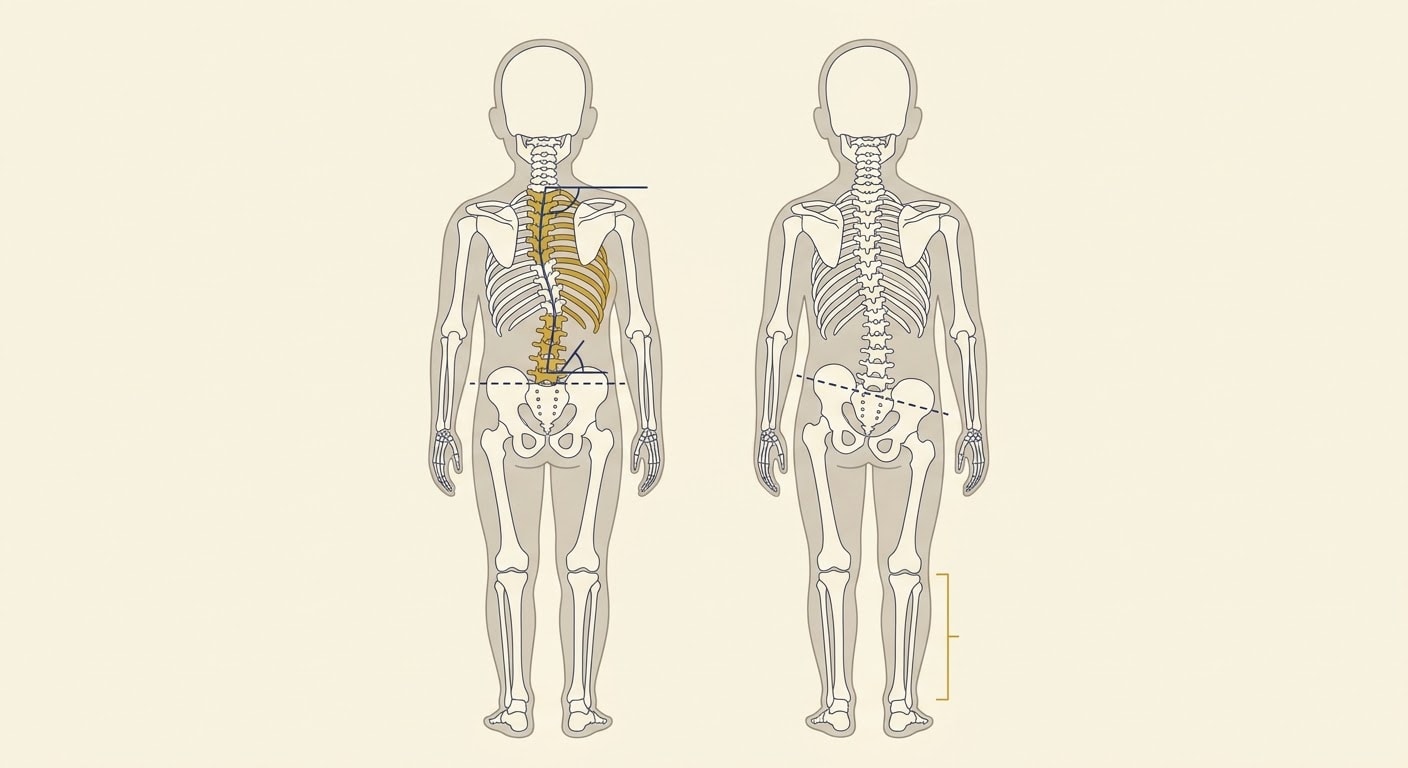
Idiopathic scoliosis affects about 1 to 3 percent of children ages 10 to 16, and girls are much more likely than boys to have curves that progress. 25 It is usually found when a parent or clinician notices asymmetry in the shoulders, ribs, or waist, or through screening. 26
What the evidence says about starting early:
- The U.S. Preventive Services Task Force found the evidence insufficient to recommend for or against screening symptom-free adolescents. 25 The AAOS, SRS, POSNA, and AAP agree that if screening is done, girls should be screened twice (ages 10 and 12) and boys once (age 13 or 14). 27
- In the BrAIST trial, bracing in skeletally immature adolescents with high-risk curves kept curves from reaching the surgical threshold more often than observation (72 percent versus 48 percent), and the benefit rose with more hours of brace wear. 3
- A Cochrane review found a lack of high-quality evidence to recommend scoliosis-specific exercise on its own, and low-quality evidence from one randomized study that exercise added to other conservative treatment improved results. 4
- Curves that begin before age 10 are considered more concerning, so ask your pediatrician promptly if you notice a curve in a younger child. 23
Posture, clumsiness, and injury risk: what the research shows
Parents often ask whether uneven posture makes a child clumsy or more likely to get hurt. The honest answer is sometimes, in some conditions, and the evidence is more limited than much online advice suggests.
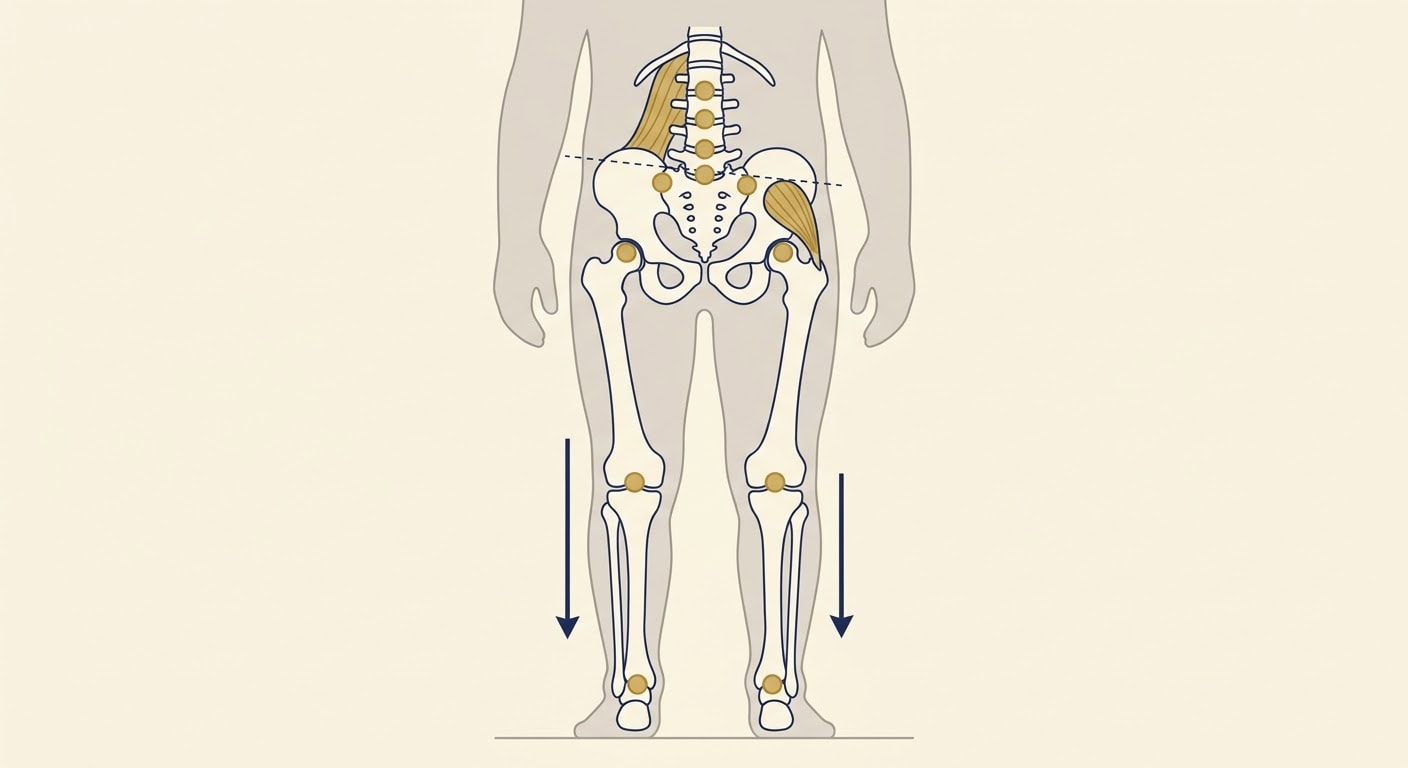
- Early motor skills. In a study comparing 82 infants with torticollis to 40 healthy infants, the torticollis group reached early motor milestones later, up to about 10 months, though time on the tummy while awake appeared to matter more than torticollis itself. 28 Another study found an increased risk of early gross motor delay that mostly normalized by one year, with no link to delayed early thinking skills. 29
- Walking. A systematic review found that gait changes may occur with leg length differences larger than 1 cm, and increase as the difference grows. 5
- Balance. A 2018 meta-analysis examined balance in adolescents with scoliosis, noting that earlier studies had inconsistent results, 6 and a 2025 study found more proprioception errors in adolescents with scoliosis, which correlated with postural instability. 30
- Compensatory injury. Most evidence on leg length differences and later joint problems comes from adults. A cohort of more than 3,000 participants found a higher likelihood of knee osteoarthritis with differences over 1 cm. Whether a leg length difference causes pain or long-term problems is debated, and studies have not consistently identified it as a risk factor for back pain. 7 A review of shoe-lift studies in adults found associations with low back pain, scoliosis, and hip and knee osteoarthritis, but rated study quality very low. 31 Some researchers have suggested links to stress fractures and running injuries. 32 In children, the long-term effects of small differences are poorly documented. 20
Posture is one possible contributor to clumsiness among many. Clumsiness that is persistent or out of proportion to your child’s peers deserves a developmental evaluation rather than an assumption that posture is the cause.
Developmental delay and early intervention
Developmental delay means a child is not reaching skills in one or more areas, such as movement, language, thinking, play, or self-care, when most children do. About 1 in 6 U.S. children ages 3 to 17 has one or more developmental delays, disorders, or disabilities, a broad category that includes attention, learning, language, and motor differences. 8 The CDC’s milestone checklists show what most children (75 percent or more) can do by each age. At 18 months, the checklist includes walking without holding on to anyone or anything, and the American Academy of Pediatrics recommends developmental screening at the 18-month visit. 33
For most of the postural findings in this guide, the main benefit of acting early is timely identification. The strongest evidence that the timing of treatment itself changes outcomes is for torticollis.
In Michigan, Early On provides free evaluations for children from birth to age 3. Call 1-800-EARLY-ON (1-800-327-5966) and ask for your local service area. 34 For ages 3 to 5, Build Up Michigan can help: 1-888-320-8384. 35 Physical therapy can run alongside these services.
What a physical therapy evaluation involves
A physical therapist watches how your child stands, walks, runs, and climbs, checks strength, flexibility, and balance, compares gross motor skills with age expectations, and looks at head, neck, spine, pelvis, leg, and foot alignment. They also screen whether an asymmetry looks structural or functional. Screening can raise or lower concern, but it cannot confirm a bone-length difference or a spinal curve. When findings point to something that needs imaging or a medical plan, the next step is your pediatrician or a pediatric orthopedist.
When treatment is indicated, it is built around play and caregiver coaching:
- Torticollis: neck range of motion, strength, and postural alignment, with caregiver training on positioning and tummy time. 9, 2
- Toe walking: calf stretching and walking practice, with referral when a medical or developmental cause is suspected. 17
- Leg length differences: strengthening and balance work, coordination with the orthopedist, and rehabilitation after surgery. 21
- Scoliosis: strength, mobility, and balance alongside the physician managing the curve, since high-quality evidence for exercise alone is lacking. 4
- Normal variations: usually reassurance and a plan for when to recheck. 1
Do you need a physician referral in Michigan?
Michigan law allows a physical therapist to evaluate and treat without a physician referral for a limited period, up to 21 days or 10 visits, whichever comes first, after which a physician referral is generally required. 36, 37 Direct access for injury prevention and fitness promotion has no time or visit limit. 37 Lawmakers have considered expanding direct access, so rules can change; confirm current requirements before starting care. If a structural problem is suspected, a physician or orthopedist will usually be involved regardless.
Questions parents ask
Are posture differences in babies and toddlers normal?
Often, yes. Most rotational and angular findings in young children are normal variations that resolve with growth. 1 Asymmetry, worsening, pain, or lost skills are reasons to ask sooner.
Does early physical therapy make a difference?
It depends on the condition. For torticollis, starting before 3 to 4 months is associated with excellent outcomes and a lower need for surgery. 2 For scoliosis, early detection matters mainly because of bracing, and evidence for exercise alone is limited. 3, 4 For normal variations such as flat feet and in-toeing, early treatment is generally not needed. 1
What is the difference between structural and functional?
In a structural problem the bones or spine themselves differ: bones of different lengths, or a fixed spinal curve with rotation. In a functional problem something else causes the appearance, such as a hip or spine problem that makes one leg look shorter, or a leg length difference, pain, or poor posture that produces a curve. 19, 23
Can torticollis cause a developmental delay?
Infants with torticollis may be at increased risk of early gross motor delay, but most normalize by about one year, and one study found time on the tummy while awake mattered more than torticollis itself. 28, 29
Does toe walking mean my child has a developmental delay?
Not necessarily. Many young children toe walk and stop by about age 2. Toe walking that persists past 2 to 3 deserves evaluation because it can be associated with neurological and developmental conditions. 17, 18
Can posture problems make my child clumsy or injury-prone?
Sometimes. Gait changes may occur with leg length differences over 1 cm, and some studies find reduced balance in adolescents with scoliosis, but evidence is mixed, and most evidence on later joint problems comes from adults. 6, 30, 5, 7
For referring clinicians
The evidence supports these timing points:
- Infants with head tilt or preferred head turning: screen from birth through six months and refer to physical therapy as soon as asymmetry is noticed. 11, 9
- Adolescents with a suspected curve: orthopedic evaluation and imaging, with physical therapy as an adjunct. 3, 4
- Children with a leg length difference: physician-confirmed measurement and growth-based prediction, with physical therapy for function and for rehabilitation after surgery. 7, 21
- Persistent toe walking past age 2 to 3: evaluation for neurological, orthopedic, or developmental causes. 18
ELEVATE contacts every referral within one business day. Referrals can be sent at elevate-therapyservices.com/refer-a-patient.
Next steps
If you are unsure what you are seeing, start with your child’s pediatrician. If a physical therapy evaluation would help, call or text (248) 266-5721, or use the referral form.
This article is for education and does not replace an evaluation by your child’s physician. Facts verified November 3, 2026. Clinically reviewed by Bryan Forton, PT, DPT, Owner, ELEVATE Therapy Services.
References
- Rerucha CM, et al. Lower extremity abnormalities in children. Am Fam Physician. 2017;96(4):226-233. https://www.aafp.org/pubs/afp/issues/2017/0815/p226.html ↩
- Physical therapy can effectively treat infants with congenital muscular torticollis (summary of the 2018 APTA guideline update). https://www.news-medical.net/news/20181003/Physical-therapy-can-effectively-treat-infants-with-congenital-muscular-torticollis.aspx ↩
- Weinstein SL, et al. Effects of bracing in adolescents with idiopathic scoliosis (BrAIST). N Engl J Med. 2013;369(16):1512-1521. https://pubmed.ncbi.nlm.nih.gov/24047455/ ↩
- Exercises for adolescent idiopathic scoliosis: a Cochrane systematic review. Spine. 2013;38(14):E883-E893. https://pubmed.ncbi.nlm.nih.gov/23558442/ ↩
- Khamis S, Carmeli E. Relationship and significance of gait deviations associated with limb length discrepancy: a systematic review. Gait Posture. 2017. https://cris.haifa.ac.il/en/publications/relationship-and-significance-of-gait-deviations-associated-with-/ ↩
- Dufvenberg M, et al. Does postural stability differ between adolescents with idiopathic scoliosis and typically developed? A systematic literature review and meta-analysis. Scoliosis Spinal Disord. 2018. https://www.ncbi.nlm.nih.gov/pmc/articles/PMC6120087/ ↩
- Vogt B, et al. Leg length discrepancy: treatment indications and strategies. Dtsch Arztebl Int. 2020;117(24):405-411. https://pmc.ncbi.nlm.nih.gov/articles/PMC7477698 ↩
- CDC. Developmental delays, disorders, and disabilities among U.S. children and adolescents, 2014 to 2018 National Health Interview Survey. MMWR. https://pmc.ncbi.nlm.nih.gov/articles/PMC8956340 ↩
- Kaplan SL, Coulter C, Sargent B. Physical therapy management of congenital muscular torticollis: a 2018 evidence-based clinical practice guideline from the APTA Academy of Pediatric Physical Therapy. Pediatr Phys Ther. 2018. https://pubmed.ncbi.nlm.nih.gov/30277962/ ↩
- Heidenreich E, Johnson R, Sargent B. Informing the update to the physical therapy management of congenital muscular torticollis evidence-based clinical practice guideline: a systematic review. Pediatr Phys Ther. 2018. https://pmc.ncbi.nlm.nih.gov/articles/PMC8317609 ↩
- Wolters Kluwer. Latest evidence to guide physical therapy for infants with congenital muscular torticollis (summary of the 2018 guideline update). https://www.eurekalert.org/news-releases/829689 ↩
- Congenital muscular torticollis: results of conservative management with long-term follow-up in 85 cases. Arch Phys Med Rehabil. 1987;68(4):222-225. https://pubmed.ncbi.nlm.nih.gov/3566514 ↩
- Cameron BH, Langer JC, Cameron GS. Success of nonoperative treatment for congenital muscular torticollis is dependent on early therapy. Pediatr Surg Int. 1994;9:391-393. https://experts.mcmaster.ca/scholarly-works/540922 ↩
- A clinical comparative study of ultrasound-normal versus ultrasound-abnormal congenital muscular torticollis. PM R. https://doi.org/10.1016/j.pmrj.2015.07.014 ↩
- Michigan Department of Health and Human Services safe sleep guidance, via Corewell Health (Beaumont). Infant safe sleep and tummy time. https://www.beaumont.org/services/childrens/health-safety/infant-safe-sleep ↩
- StayWell. Babies need "tummy time." https://healthlibrary.ecuhealth.org/wellness/vida-saludable/babies-need-tummy-time ↩
- Perth Children's Hospital. Toe walking pre-referral guideline. https://pch.health.wa.gov.au/For-health-professionals/Referrals-to-PCH/Prereferral-guidelines/Toe-walking ↩
- Toe walking: when do we need to worry? https://pubmed.ncbi.nlm.nih.gov/28716514/ ↩
- NYU Langone via StayWell. When your child has leg-length discrepancy (LLD). https://nyulangoneib.staywellsolutionsonline.com/Library/Encyclopedia/22,89068 ↩
- Leg length discrepancy: the natural history (and what do we really know). J Pediatr Orthop. https://doi.org/10.1097/BPO.0000000000001396 ↩
- UM Health (StayWell). When your child has leg-length discrepancy (LLD). https://www.ummhealth.org/health-library/when-your-child-has-leg-length-discrepancy-lld ↩
- Grady Health (StayWell). When your child has leg-length discrepancy (LLD). https://healthlibrary.gradyhealth.org/orthopedics/types/when-your-child-has-leg-length-discrepancy-lld ↩
- RACGP. Paediatric scoliosis. https://www1.racgp.org.au/getattachment/c57c88e6-4b08-4074-a594-f50ffe9eddb9/Paediatric-scoliosis.aspx ↩
- Sekiya T, et al. Evaluation of functional and structural leg length discrepancy in patients with adolescent idiopathic scoliosis using the EOS imaging system. Scoliosis Spinal Disord. 2018. https://www.ncbi.nlm.nih.gov/pmc/articles/PMC5910610/ ↩
- US Preventive Services Task Force. Adolescent idiopathic scoliosis: screening. JAMA. 2018;319(2):165-172. https://www.uspreventiveservicestaskforce.org/Page/Document/RecommendationStatementFinal/adolescent-idiopathic-scoliosis-screening1 ↩
- Kuznia AL, Hernandez AK, Lee LU. Adolescent idiopathic scoliosis: common questions and answers. Am Fam Physician. 2020;101(1):19-23. https://www.aafp.org/pubs/afp/issues/2020/0101/p19.pdf ↩
- AAOS, SRS, POSNA, and AAP joint position statement on scoliosis screening, as summarized by Hresko MT, Talwalkar V, Schwend R. https://core.ac.uk/download/232581017.pdf ↩
- Ohman A, et al. Are infants with torticollis at risk of a delay in early motor milestones compared with a control group of healthy infants? Dev Med Child Neurol. 2009;51(7):545-550. https://pubmed.ncbi.nlm.nih.gov/19191832/ ↩
- Motor and cognitive development at one-year follow-up in infants with torticollis. Early Hum Dev. 2008. https://www.qxmd.com/r/17363197 ↩
- Koura G, et al. Proprioceptive deficits and postural instability in adolescent idiopathic scoliosis. Front Pediatr. 2025. https://www.frontiersin.org/journals/pediatrics/articles/10.3389/fped.2025.1595125/full ↩
- Campbell TM, et al. Shoe lifts for leg length discrepancy in adults with common painful musculoskeletal conditions: a systematic review. Arch Phys Med Rehabil. 2018;99:981-993. https://search.pedro.org.au/search-results/record-detail/53063 ↩
- UNC Health Talk. Leg-length inequality ("short-leg syndrome") and knee and hip osteoarthritis. https://healthtalk.unchealthcare.org/?p=5388 ↩
- CDC. Learn the Signs. Act Early. Milestones by 18 months. https://www.cdc.gov/act-early/milestones/18-months.html ↩
- Michigan Department of Education. Early On Michigan. https://michigan.gov/mikidsmatter/programs/early-on ↩
- Michigan Department of Education. Early On and Build Up Michigan referral process. https://eotta.ccresa.org/Files/Uploads/New/3417/NEW_MI_EarlyOn_BuildUp_Graphic_Org_MDE.pdf ↩
- Michigan Senate Fiscal Agency. Direct access to physical therapy in Michigan (OneFAB, July 2025). https://sfa.senate.michigan.gov/Publications/OneFAB/2025/OneFAB07-07-2025ak.pdf ↩
- Rehab Management. Michigan law called milestone for improved patient access to PTs (APTA release on SB 690). https://rehabpub.com/clinic-management/regulatory/michigan-law-called-milestone-improved-patient-access-pts/ ↩


Recent Comments